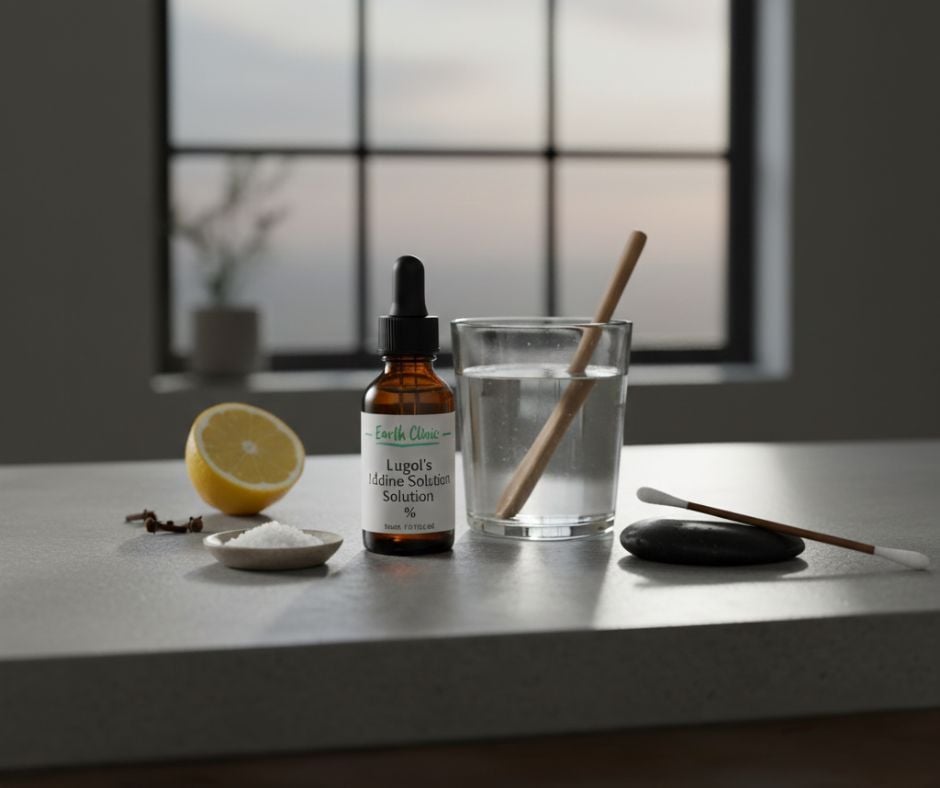
Iodine is one of Earth Clinic's most consistently reported natural remedies for sore throats — with readers describing relief ranging from hours to overnight, using a method that most people have never heard of: painting iodine on the skin of the throat and wrists rather than swallowing it. This external application approach has been documented in reader posts since at least 2005, with a strong track record for early-stage sore throats.
This page covers the three main iodine approaches discussed by Earth Clinic readers — external painting, direct throat painting, and antiseptic gargling — along with timing, which type of iodine to use, practical application tips, and important safety precautions around thyroid health.
Important: Iodine directly affects thyroid function and immune signaling. Even topical use involves some systemic absorption. People with Hashimoto's disease, hyperthyroidism, thyroid nodules, or those taking thyroid or lithium-based medications should consult a healthcare provider before using iodine in any form. The information below is based on Earth Clinic reader experiences and is provided for educational purposes only.
At a Glance
- External iodine painting on the throat and inner wrists is Earth Clinic's primary sore throat method — applied to skin, not swallowed.
- Works best when applied at the very first sign of throat irritation — timing is critical.
- Three methods: external skin painting, direct throat painting with a swab or spray, and povidone-iodine gargling.
- Decolorized (clear) iodine avoids the staining problem of standard brown iodine.
- A spray bottle is recommended for direct tonsil application.
- People with thyroid conditions should consult a healthcare provider before using iodine.
- If iodine is slow to work, garlic is the most commonly recommended backup.
Earth Clinic Experience:
Earth Clinic readers have reported using iodine for sore throats since at least 2005 — one of the older and most consistently positive remedy discussions on the site. The reader base includes multi-generational users who describe iodine as a first-response household remedy, and the practical knowledge accumulated about application methods, timing, and iodine type is detailed and specific.
What Earth Clinic Readers Report About Iodine for Sore Throat
After nearly two decades of reader posts on iodine and sore throats, several clear patterns have emerged.
Timing is everything — early use is dramatically more effective
The single most important factor in these posts is timing. HisJewel from New York articulates what many others have observed: when iodine painting is applied at the very first sign of throat irritation, it can work within minutes. Hannah from Morgantown felt a difference in about 10 minutes. Quita from Atlanta describes severe throat pain — unable even to swallow — being completely gone the next morning after one evening application. The contrast with late treatment is stark: Lauren from San Diego tried iodine painting after 4 days of an established sore throat and got yellow staining but no relief. The explanation is consistent — iodine works best when the pathogen load is still low.
The wrist and throat painting method surprises everyone who tries it
The most counterintuitive aspect of this remedy is that iodine is applied externally to the skin rather than swallowed or gargled. Quita from Atlanta describes thinking her friend was "crazy" when she suggested painting the inside of her wrist for a sore throat. Seymore from Portland describes initially finding it "weird trying to cure something that was affecting your body at the throat and cure it by painting iodine at the wrists." Annavas from Missouri's daughter "thought I was crazy" — then had instant relief. This pattern of skepticism followed by surprise is consistent across two decades of posts.
Loni's tonsil story — a standout long-term report
Loni describes using iodine for everything in her family across multiple generations. Her most compelling account: her son was scheduled to have his tonsils removed, and she tried painting his tonsils directly with iodine using a spray bottle first. It worked within 24 hours — and he never had tonsil problems again. She notes that iodine dries quickly, so very little is actually swallowed with this method. Her family has used it as a first-response remedy for years.
Most experienced users make it a household first-response remedy
A pattern across Earth Clinic's iodine posts is that experienced users apply iodine at the very first sign of throat irritation rather than waiting to see if symptoms worsen. The readers who describe it working "every time" — Dottie from South Georgia, Greg from Atlanta, Nancy from Austin — all share this early-application habit. These are not one-time experiments but established household protocols maintained over years.
Garlic is the most recommended backup when iodine is slow
HisJewel from New York provides practical guidance on what to do when painting doesn't produce rapid results: reach for garlic immediately rather than giving the infection more time to establish. A couple of chews on one clove, or a few chops with a knife swallowed with cold water, is described as "often a sure hit." Lemon garlic tea is another option. The practical approach is to combine both antimicrobial remedies rather than abandon one for the other.
How External Iodine Works for Sore Throat
The mechanism of external iodine painting involves both transdermal absorption and lymphatic support:
- Transdermal absorption: Iodine applied to skin — particularly over thin-skinned areas with superficial veins like the inner wrist — is absorbed through the skin and enters circulation. Once absorbed, iodine has direct antimicrobial and immune-supporting properties.
- Local lymphatic support: Painting iodine over the throat area — particularly over swollen lymph nodes and glands — is thought to support lymphatic drainage and local immune signaling in the cervical lymph nodes that filter throat infections.
- Direct antiseptic action: When applied directly to throat or tonsil tissue (via swab or spray), iodine acts as a powerful broad-spectrum antiseptic, disrupting bacterial and viral activity on contact.
External Skin Painting Method
This is the most commonly discussed method and the one most readers start with.
External Painting Protocol
- Apply iodine to the inner wrists — specifically where veins are closest to the skin surface. Use a cotton ball or swab. Decolorized (clear) iodine is preferred here to avoid staining clothing.
- Apply iodine to the sides of the throat — paint the external skin over the areas that hurt inside, and over any swollen glands. For one-sided sore throats, paint the side that hurts.
- Leave on — do not wash off. Leaving iodine on the throat overnight is a commonly reported approach, with readers waking to find significant improvement.
- Apply at the very first sign of irritation — do not wait until the throat is severely inflamed.
Direct Throat Painting Method
Several readers describe applying iodine directly to throat tissue — either with a swab or using a spray bottle — for more immediate antiseptic contact.
Mary T. from Pikesville recalls that as a child, nuns at her boarding school would paint iodine directly into students' throats with a swab. Loni took this further with the spray bottle method described in the section below.
For direct throat application, decolorized (clear) iodine or properly diluted povidone-iodine is preferable to undiluted standard brown iodine, which can be irritating to mucosal tissue at full strength.
Spray Bottle Method for Tonsils
Loni's Protocol:
Pour iodine into a small spray bottle. Open mouth wide and spray directly onto the tonsils and back of the throat. Iodine dries quickly, so very little is swallowed. This method delivers direct antiseptic contact to tonsil tissue without requiring swabbing — and is the approach Loni credits with avoiding her son's scheduled tonsillectomy.
Important: Use only appropriately diluted iodine for direct throat application. A diluted solution (approximately 1 part iodine to 10–20 parts water) is more appropriate for direct contact with throat tissue. Do not swallow.
Povidone-Iodine Gargle Method
Povidone-iodine (PVP-I) gargles are the most researched iodine application for throat infections. Povidone-iodine is a broad-spectrum antiseptic particularly effective at disrupting pathogenic biofilms — the protective layers bacteria and viruses use to shield themselves from the immune system.
Povidone-Iodine Gargle Protocol
- Use povidone-iodine 10% solution (e.g., Betadine)
- Dilute to approximately 1% — about 1 part iodine to 20 parts water
- Gargle for 20–30 seconds and spit out — do not swallow
- Use 1–2 times daily for short periods during acute symptoms only
- Best for established throat infections where direct antiseptic contact is needed
Diane from San Miguel de Allende describes mixing a capful of iodine with a glass of water and gargling — a similar approach using standard iodine. Keep concentrations low and never swallow.
Which Type of Iodine to Use
Iodine Types for Sore Throat
Decolorized (clear) iodine: The most practical choice for painting — provides all the antiseptic benefits of standard iodine without the brown staining. Available at most drugstores. Particularly useful when painting the neck and throat area where staining on clothing is a concern.
Standard brown iodine (tincture of iodine): The classic household iodine. Works well for painting but stains skin, clothing, and furniture significantly. See the staining section below for management tips.
Lugol's iodine: A stronger iodine solution discussed elsewhere on Earth Clinic for systemic supplementation. Some readers use it for throat painting but it requires more careful dilution for direct tissue contact.
Povidone-iodine (Betadine): The preferred choice for gargling — better studied for this purpose, more consistent concentration, and widely available.
Why Timing Is Critical
The difference between iodine applied at the very first sign of throat irritation and iodine applied after a 4-day established infection is, based on reader reports, the difference between dramatic overnight results and no results at all. Iodine's antiseptic action is most effective when the pathogen load is still low — before infection is well-established and replicating at full speed.
The practical implication: keep iodine accessible and use it immediately when you notice the first hint of throat scratchiness or tenderness. Don't wait to see if it develops. The readers who describe iodine working reliably have internalized this as their rule.
Combinations Readers Use
- Iodine painting + garlic: The most recommended combination when iodine alone is slow — chewing or chopping a clove and swallowing with cold water, or lemon garlic tea alongside the painting.
- Iodine painting + honey: Igor from Toronto describes applying iodine to the neck and then taking a teaspoon of honey — throat soreness resolved within an hour. Honey has its own antimicrobial properties and soothes irritated tissue.
- External painting + povidone-iodine gargle: Using both simultaneously — gargling for direct throat antiseptic action while painting externally for lymphatic support and transdermal delivery.
- Iodine + apple cider vinegar: For readers where iodine alone hasn't worked after a few days, ACV gargling is the most commonly recommended alternative to try next.
Practical Tips: Avoiding Iodine Stains
Standard brown iodine stains skin yellow-orange and will permanently stain fabric. John from Panama City offers the most detailed practical guidance:
- Place towels over wherever your wrists and hands normally rest after application
- Wear clothing you don't mind possibly staining
- If profuse sweating is a concern, be particularly careful as iodine spreads with moisture
- Simplest solution: Use decolorized (clear) iodine — it eliminates the staining problem entirely
- Skin staining from standard iodine fades over 1–2 days and is not harmful
Thyroid Safety
Important Thyroid Considerations
Iodine directly affects thyroid function. Even topical application involves some systemic absorption. Brenda from Toronto specifically flagged this in reader posts: iodine can be dangerous for those with Hashimoto's disease, and anyone who is hypothyroid should check with a doctor first.
- Hashimoto's disease: Iodine can trigger or worsen autoimmune thyroid flares. Avoid without medical supervision.
- Hyperthyroidism: Iodine can exacerbate an already overactive thyroid. Avoid without medical supervision.
- Thyroid nodules: Consult a healthcare provider before using iodine regularly.
- Pregnancy and breastfeeding: Iodine requirements change significantly; use only under medical guidance.
- Lithium medications: Lithium and iodine interact at the thyroid level. Consult your prescriber.
- For most people with normal thyroid function: Occasional short-term topical use for sore throat is generally considered low risk, but frequent or long-term use should be approached cautiously.
Safety and When to See a Doctor
Important Safety Information
- Do not swallow iodine painting solutions or gargling solutions — spit out gargles completely.
- Do not use undiluted iodine directly on throat tissue — dilute appropriately for any direct mucosal application.
- Avoid long-term or high-frequency use to prevent thyroid suppression.
- Discontinue immediately if you experience palpitations, rash, or worsening symptoms.
- Iodine allergy is rare but possible — discontinue if allergic symptoms occur.
- Seek medical care if: fever is present or worsening, difficulty swallowing or breathing occurs, symptoms last more than 48–72 hours without improvement, or you suspect strep throat (which requires antibiotic treatment).
Frequently Asked Questions
How do you use iodine for a sore throat?
The most commonly reported method is external painting: apply iodine to the inside of both wrists and to the sides of the throat over the painful areas. Leave on — do not rinse. Apply at the very first sign of throat irritation. Some readers also use a spray bottle to apply diluted iodine directly to the tonsils, as described in Loni's protocol above.
Does iodine painting really work for sore throats?
Many readers report consistent results, particularly when iodine is applied early. Experienced users who apply it at the very first sign of throat irritation describe it working reliably. Results are less consistent for established infections that have already progressed over several days.
What type of iodine should I use for sore throat?
Decolorized (clear) iodine is the most practical choice for skin painting — same benefits as standard iodine without staining. Standard tincture of iodine works but stains. Povidone-iodine (Betadine) is preferred for gargling. Lugol's iodine requires careful dilution for any topical use.
Why do you put iodine on your wrists for a sore throat?
The inner wrist is where veins are closest to the skin surface, allowing better transdermal absorption into circulation. Once absorbed, iodine has antimicrobial and immune-supporting properties that may help address throat infections systemically alongside the throat painting.
Is it safe to paint iodine on your throat?
External skin painting over the throat area is generally considered safe for short-term use in people with normal thyroid function. Direct application to throat mucosal tissue should use diluted iodine only. People with thyroid conditions should consult a healthcare provider first. Do not swallow iodine.
What if iodine doesn't work for my sore throat?
If painting doesn't produce improvement within a few hours, add garlic immediately — chewing or chopping a clove and swallowing with cold water, or making lemon garlic tea. Apple cider vinegar gargling is another commonly recommended alternative. If symptoms are severe or worsening, seek medical evaluation.
Can I use iodine for sore throat if I have thyroid disease?
Not without medical supervision. Iodine directly affects thyroid function and can trigger or worsen conditions including Hashimoto's and hyperthyroidism. Consult your healthcare provider before using iodine in any form if you have thyroid disease.
Can I gargle with iodine for a sore throat?
Yes — diluted povidone-iodine gargling is well-studied with documented antimicrobial activity against throat pathogens. Use approximately 1 part povidone-iodine 10% solution to 20 parts water, gargle for 20–30 seconds, spit out completely. Do not swallow. Use for short periods only during acute symptoms.
Takeaway
Iodine for sore throat is one of Earth Clinic's oldest and most consistently reported remedies — particularly effective when applied externally at the first sign of throat irritation, before infection is established. The external painting method is the most commonly used approach; Loni's spray bottle method provides more direct tonsil contact; and povidone-iodine gargling works for established infections. Decolorized iodine eliminates the staining problem. Timing matters more than almost any other factor — and garlic is the recommended backup when iodine needs help.
Scroll down to read Earth Clinic reader experiences with iodine for sore throats, swollen glands, and throat infections.
Experiences With Iodine for Sore Throat
Below are Earth Clinic reader reports on using iodine painting and gargles for sore throats, tonsil infections, swollen glands, and related conditions.
Related Links:
Natural Sore Throat Remedies: 10 Fast-Acting Community Favorites





