
A Guide to Natural Pyometra Treatment in Dogs: The Reader-Tested Protocol

| Modified on Sep 10, 2026
Add New Post Comments
Pyometra Remedies for Dogs

Pyometra is a potentially life-threatening infection of the uterus in an unspayed female dog. Earth Clinic readers have shared moving accounts of Manuka honey, turmeric, vitamin C, and other approaches. Those experiences deserve to be preserved—but they must be placed beside the essential fact that pyometra can progress to sepsis, shock, uterine rupture, and death, sometimes with very little warning.

Urgent veterinary care is needed today: An unspayed female dog with vaginal discharge, lethargy, vomiting, poor appetite, weakness, fever, increased thirst/urination, abdominal enlargement, panting, pale gums, or collapse should be examined immediately. A dog may have closed pyometra without discharge. Do not wait for supplements to arrive or for a home protocol to “prove itself.”

Quick Answer: What to Know About Manuka Honey, Turmeric & Vitamin C

  • Manuka honey: There is no proven MGO rating or oral dose for treating canine pyometra. MGO measures methylglyoxal content; it does not establish effectiveness for a uterine infection. If a veterinarian permits honey as a small food-support addition, use only plain, pasteurized Manuka honey with no added sweeteners, flavors, essential oils, or supplements—not a product marketed as a pyometra treatment.
  • Turmeric: There is no veterinary-approved turmeric or curcumin form for pyometra. Do not use highly concentrated human curcumin extracts, piperine/black-pepper “absorption” blends, or multi-herb formulas without the prescribing veterinarian’s approval; they can interact with medicines and may upset the stomach.
  • Vitamin C: There is no established vitamin C form or megadose for curing pyometra. Ascorbic acid can cause gastrointestinal upset; sodium ascorbate adds sodium; and calcium ascorbate is not automatically safer. Do not give human gummies, flavored powders, or chewables without checking every ingredient for xylitol, which is extremely toxic to dogs.

Why Pyometra Cannot Be Managed by Symptoms Alone

Pyometra usually develops after a heat cycle as hormonal changes make the uterus vulnerable to infection. The highest-risk window is commonly 2 to 8 weeks after a heat cycle ends—often when an owner no longer connects new symptoms to the heat. Any unspayed dog who becomes unwell in that window should be considered at risk until a veterinarian rules pyometra out. Diagnosis requires a veterinarian—often with examination, blood tests, ultrasound and/or x-rays—to determine whether the uterus is infected and whether the dog is becoming systemically ill.

Risk rises with age and repeated heat cycles, so intact middle-aged and older dogs deserve particular vigilance. Breed associations have been reported in some populations, but they vary by study and country; age, reproductive status, and the timing after heat are more useful home-level risk clues than breed alone.

  • Open pyometra: The cervix is open and discharge may drain from the vulva. Although visible discharge can alert an owner, it does not mean the infection is mild or safe to watch at home.
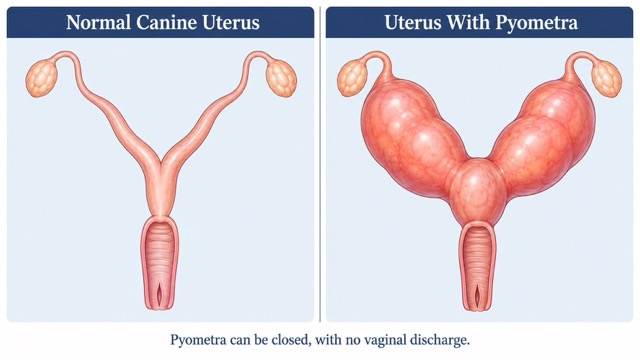
  • Closed pyometra: The cervix is closed, trapping infected fluid in the uterus. There may be no discharge. This can deteriorate extremely quickly and the uterus can rupture.
Diagram comparing a normal canine uterus with a uterus distended by pyometra
A normal uterus compared with a pyometra uterus distended by infected fluid. With closed pyometra, this dangerous buildup may occur without any vaginal discharge.
Important: A decrease or disappearance of discharge is not proof that pyometra has resolved. It can be a good sign, but it can also occur when drainage stops. Only a veterinary recheck, often including imaging and bloodwork, can assess whether the uterus and the dog are truly improving.

The Standard of Care—and Options When Surgery Is High Risk

Emergency ovariohysterectomy (spay) plus stabilization, IV fluids as indicated, pain control, and antibiotics is generally the definitive treatment for pyometra. It removes the infected uterus and prevents recurrence. Age or heart disease makes anesthesia more complex, but it does not make active pyometra safe; ask for a frank discussion of anesthetic risk versus the risk of untreated infection, and whether referral to an emergency/specialty hospital is possible.

For carefully selected breeding dogs with open pyometra, veterinarians may discuss medical protocols using drugs such as aglepristone where available and/or injectable prostaglandin F2α, together with antibiotics and close monitoring. These treatments seek to lower progesterone influence and empty the uterus; they are not interchangeable with honey or supplements. They are not appropriate for a severely ill dog, closed pyometra, or an at-home trial, and they can cause substantial side effects and still fail.

Cost and access: act early and ask direct questions

There is no reliable national price because location, size of dog, severity of infection, after-hours admission, testing, IV fluids, transfusion needs, and ICU care all change the estimate. A routine low-cost spay can cost far less than a pyometra operation, while emergency pyometra care often reaches several thousand dollars and can be higher with hospitalization. Ask for a written estimate that separates diagnostics, surgery, stabilization, hospitalization, and medications; ask what stabilization is needed immediately; and ask about payment plans, CareCredit/Scratchpay, local humane societies, municipal shelters, veterinary-school hospitals, and rescue-linked assistance. Cost should trigger an urgent financial conversation with the clinic—not a delay in diagnosis.

Prompt surgery has a generally good prognosis. The American College of Veterinary Surgeons reports survival after ovariohysterectomy can be as high as 80–100% when abdominal contamination is avoided and systemic infection responds to treatment; severe sepsis, organ failure, or uterine rupture worsens the outlook.

Research Snapshot: Manuka honey has useful topical wound-care properties and laboratory antimicrobial activity. That is not the same as evidence that orally administered honey reaches and clears an infected canine uterus. There are no clinical trials establishing a Manuka MGO level, turmeric form, or vitamin C regimen as treatment for canine pyometra.

What Earth Clinic Readers Have Reported

Readers have written about dogs who seemed to recover while receiving Manuka honey, turmeric, vitamin C, antibiotics, or combinations of remedies; several later chose spaying to prevent recurrence. Other readers reported no benefit from the honey/turmeric/vitamin C combination and tried additional herbs. These posts offer comfort and ideas for questions to take to an integrative veterinarian, but cannot show which ingredient helped, whether the dog had confirmed pyometra, or whether the infection would recur.

Several reports rightly emphasize hydration, gentle cleaning of discharge, tempting cooked food when a dog will eat, and follow-up spaying. The safest update to those posts is: use supportive food only if the dog is alert and willing to eat, never force food or liquids into a weak, nauseated, or struggling dog, and do not give a mixture by syringe if there is an aspiration risk. Veterinary stabilization is the priority.

Manuka Honey: Understanding MGO and Product Safety

MGO is a label measurement of methylglyoxal in Manuka honey. A higher number means more methylglyoxal in the jar; it does not tell us what amount is absorbed after oral use, whether it reaches the uterus, or what MGO level would treat pyometra. Therefore, Earth Clinic cannot recommend MGO 100, 400, 550, “16+,” or any other grade as treatment.

If the dog’s veterinarian says a small amount of honey is acceptable as a palatability aid, choose a plain, food-grade product from a reputable brand. Avoid products containing xylitol, chocolate, caffeine, added botanicals, essential oils, alcohol, or proprietary blends. Honey is sugar-rich and needs special caution in diabetes, obesity, pancreatitis history, dental disease, and dogs with nausea or diarrhea. It should never delay antibiotics, imaging, or surgery.

Turmeric and Curcumin: What Form Is Safest to Discuss?

Turmeric is a culinary spice; curcumin is one of its active constituents. Concentrated curcumin products can behave more like a drug than a food. No product form has been shown to treat canine pyometra.

  • Plain culinary turmeric powder: the least concentrated option, but it still can cause vomiting or diarrhea and may be unsuitable for a dog with gallbladder disease, a bleeding tendency, or an upcoming operation.
  • Standardized curcumin capsules/liquids: not a default choice in a seriously ill dog. Potency varies widely, and they can interact with medications or affect platelet function.
  • Curcumin plus piperine/black pepper: avoid unless the veterinarian explicitly approves it. Piperine can alter drug metabolism and absorption, which is a poor tradeoff when antibiotics, pain medicine, or anesthesia may be needed.

Do not rely on “better absorption” marketing during an emergency. Bring the exact label to the veterinarian and let them decide whether any turmeric product is appropriate.

Vitamin C: Form, Sodium, and Xylitol

Dogs normally make vitamin C in the body, and there is no established oral vitamin C protocol for pyometra. In a sick dog, vomiting, diarrhea, dehydration, and kidney strain are already concerns—so high doses are not benign.

Form Practical point
Ascorbic acid Acidic and more likely to irritate the stomach or cause loose stool in some dogs.
Sodium ascorbate Buffered, but adds sodium; this is a medical consideration, not a reason to assume it is risk-free.
Calcium ascorbate Buffered, but supplies calcium and still may cause gastrointestinal effects or be inappropriate for the individual dog.
Human flavored products Avoid unless every inactive ingredient is checked. Xylitol, gummies, caffeine, and added herbs can be dangerous.

Rather than choosing a form from a web protocol, ask the treating veterinarian: “Does my dog need supplemental vitamin C at all, and if so, what product and amount fit her kidney values, diet, antibiotics, and surgical plan?”

Do Not Add These Without Veterinary Approval

  • Garlic: it can damage red blood cells and cause hemolytic anemia in dogs. Do not use it as an antibiotic substitute.
  • Goldenseal, echinacea, and multi-herb “infection” blends: these have uncertain dosing, may interact with drugs, and can complicate a critically ill dog’s care.
  • Yunnan Baiyao: it is not proven treatment for pyometra, varies by product, and should only be used under veterinary direction—particularly where bleeding, surgery, liver disease, or multiple medicines are involved.
  • Human pain medicine: acetaminophen, ibuprofen, naproxen, and aspirin can be dangerous in dogs, especially during dehydration, infection, or kidney stress.

Safe Support While Arranging or Following Veterinary Care

  • Keep fresh water available unless the veterinarian gives a specific different instruction.
  • Keep the dog calm, cool, and indoors; limit activity to short, gentle toileting trips.
  • Note discharge color/odor/amount, appetite, vomiting, drinking, urination, energy, gum color, and abdominal size—but do not interpret a change in discharge as clearance.
  • Gently clean only the external fur and skin with warm water and a soft cloth, then pat dry. Never douche, flush, or syringe water, honey, herbs, antiseptics, or any remedy into the vulva/vagina. Internal rinsing may force infected material farther inward, introduce bacteria, delay proper treatment, or injure fragile tissue in a severely compromised uterus. Do not insert anything into the vagina or use essential oils on the area.
  • Give prescribed antibiotics and other medication exactly as directed, and return for all scheduled rechecks.

Can a Spayed Dog Get Pyometra?

Rarely, yes. Stump pyometra can occur when residual uterine tissue becomes infected, usually in the presence of remaining ovarian tissue or hormone exposure. A spayed dog with discharge, lethargy, vomiting, increased thirst, or a painful abdomen still needs prompt veterinary assessment; do not assume pyometra is impossible because she was spayed.

Frequently Asked Questions

Which MGO Manuka honey should I buy for pyometra?

None can be recommended as treatment. There is no evidence-based MGO threshold or oral dosage for canine pyometra. A product’s MGO rating does not make it a substitute for emergency veterinary care.

Should I use turmeric powder or a 95% curcumin supplement?

Neither is established treatment. Do not assume the concentrated product is better; it may be harder on a sick dog and more likely to interact with medication. Check with the veterinarian before using any turmeric product.

Which vitamin C is best?

There is no best form for treating pyometra. The right answer depends on whether supplementation is even appropriate for that dog. Avoid xylitol-containing human products and do not use high-dose internet protocols without veterinary direction.

Can pyometra resolve without treatment?

It should not be expected to resolve safely without veterinary treatment. Untreated infection can lead to sepsis, kidney injury, uterine rupture, and death. A dog that appears better or stops discharging may still have dangerous infection; prompt veterinary recheck is essential.

How is pyometra distinguished from other causes of vaginal discharge?

Heat-related bleeding, vaginitis, urinary tract disease, trauma, pregnancy-related problems, tumors, and other conditions can cause discharge. The timing after heat, examination, bloodwork, urine testing, ultrasound and/or x-rays, and sometimes vaginal cytology help the veterinarian distinguish pyometra from these problems. Because closed pyometra may have no discharge, absence of discharge cannot rule it out.

Can natural remedies prevent pyometra from coming back?

No natural protocol has been shown to prevent recurrence. Spaying is the definitive prevention for dogs not intended for carefully managed breeding.

Bottom Line

Earth Clinic’s community stories may help an owner feel less alone and can inform a conversation with an integrative veterinarian. They do not establish that Manuka honey, turmeric, vitamin C, Yunnan Baiyao, garlic, or herbs can clear pyometra. The safest answer to the reader’s question is not a higher MGO number or a stronger curcumin: it is prompt veterinary evaluation, with any supportive product cleared by the clinician managing the dog’s infection and surgery risk.

Need emergency help now? Call your regular veterinarian; their voicemail often directs after-hours emergencies. You can also use the AAHA hospital locator or the ACVS surgeon locator, and search for a 24-hour emergency veterinary hospital near you. If your dog is weak, collapsed, has pale gums, labored breathing, repeated vomiting, or a painful/swollen abdomen, go now rather than waiting for an online response.

Veterinary Sources

Related Links:

Vitamin C for Pyometra - #2 Most Popular Remedy
Vitamin C, Turmeric, Manuka Honey for Pyometra - #1 Most Popular


The comments below reflect the personal experiences and opinions of readers and do not represent medical advice or the views of this website. The information shared has not been evaluated by the FDA and is not intended to diagnose, treat, or prevent any disease or health condition. Always consult a qualified healthcare professional for medical concerns.

Black Seed Oil, Manuka Honey


Posted by R (Las Vegas ) on 05/12/2024
★★★★★

Has anyone tried treating open pyometra with black seed oil? My 12 yr old husky was just diagnosed with pyo and believe that surgery would be too big a risk. We are currently giving her antibiotics from the ER bet they prescribed Enrofloxacin and AmoxClav. Plus giving her a spoon of manuka honey and rubbing black seed oil on her topically where her uterus is and about 1-2 ml orally. She is sooo much better! Appetite is incredible and eating her food and treats. Also drinking and go for short walks. Please has anyone tried black seed oil? Just want to make sure she gets rid of infection completely

Replied by Tameka
(Uk)
05/28/2024

Hello! Really lovely to see another dog owner using black seed oil. Would love to hear how your girl is doing and if any other natural herbs etc that you are using to keep her string and healthy?


Cinnamon Extract


Posted by Susan (Minnesota) on 04/26/2021
★★★★☆

I want to add to your treatments to pyometra. I have an English Mastiff. She lost 30 pounds and was diagnosed by a vet for pyometra. The small town vet was very rude to me and wanted to euthanize my girl. the very day. I took her home and began giving her cinnamon extract capsules stuffed into little sausages. I only had a partial bottle, and they were getting old. By the time she had finished them, (and I had her on antibiotics from the vet, before that), she had gained all her weight back. I was very upset that the vet would have euthanized her. She remained very active and healthy for quite awhile. But now she went into heat and began to favor her left rear leg. I thought she may have stepped on a roofing nail, so bathed her entire foot in Listerine, and soaked in iodine, which she licked off. She was losing weight again, and I thought it was from an infected foot. So I put a mustard pack on it, which she licked off. And I treated it daily with iodine. Now, she has gotten worse, and I ordered the manuka honey, vitamin C and Tumeric spice. But I have been out of the cinnamon extract. I am ordering today. But I think I waited too long, as she is throwing up and not eating. She also has a foul smell. Here is the cinnamon extract, https://www.swansonvitamins.com/swanson-superior-herbs-cinnamon-extract-250-mg-90-caps?expandProductReviews=t#customer-review-details and also some info. https://www.healthline.com/nutrition/10-proven-benefits-of-cinnamon. I hope this helps.


Echinacea and Goldenseal


Posted by Jim (Los Angeles, Ca) on 11/16/2017
★★★★★

Editor's Choice

My dog had Open Pyometra recently. I tried the Manuka Honey, Vitamin C, Turmeric, but they did not work. After doing much research I gave her the Now brand Echinacea and Goldenseal root 225/225mg blend for 2 weeks. She started to clear up within a few days and within 2 weeks was completely cured.

My dog weighs 65 pounds, and that dosage worked for her. The Echinacea boosts the immune system and the Goldenseal is an antibiotic. I gave her 1 capsule in the morning and 1 capsule in the evening. I mixed it in with a little canned food, which she loves.

Replied by Cindy
(Ca)
12/29/2017

How is your dog doing as of now?

Replied by Jim
(Los Angeles, Ca)
02/05/2018

She is cured. She has not had a recurrence. I am considering having her spayed before her next heat in order to avoid a possible future occurrence.

EC: Wonderful news! Thanks for reporting back!

Replied by Fatmah
(Honolulu)
04/03/2018

Saw your comments. one capsule each of the Echinacea and Goldenseal root 225/225mg? My dog is about 20lbs.

Thanks


Echinacea, Goldenseal, Vitamin C


Posted by Hannah M (Houston) on 07/23/2021 5 posts
★★★★★

Update to my post on July 23:

I first did the Manuka honey, Tumeric and vitamin C but it did not work.

I then did Echinacea and Goldenseal 225/225 mg. I gave it to her for 2 weeks, along with 2,000 mg of vitamin c twice a day.

At the end of the first week, her discharge stopped but I kept on for another week. At the end of the second week, she was completely healed. I had her spayed 3 weeks later so it doesn't reoccur.

I would recommend Echinacea and Goldenseal 225/225 mg if the first remedy does not work for you.

Thank you for this site, my girl is healthy and recovering from her spay surgery.


Fresh Garlic


Posted by Christina (CA) on 01/25/2023
★★★★★

My female shih tzu had Pyometra twice. First time we took her to the vet and got antibiotics and the turmeric/honey mixture worked wonders for her. She got it again a few months ago after finishing her heat cycle. This time around was much worse - her discharge was SO heavy and we thought we were going to lose her. We did the turmeric/honey mixture, added cinnamon to it too, and used homeopathic remedies. Nothing helped. Started giving her fresh, chopped up garlic that we let sit out for at least 10 min to let the allicin activate. Gave her 1/4 tsp twice a day for about two weeks. She recovered within days. Truly a miracle. She is all better now and healthier than ever. Don't listen to what people say about garlic being poisonous to dogs - she is neither anemic nor sick in any way. Do your research for correct dosage for your dog. Will be getting her spayed next week to prevent Pyometra from happening ever again now that she has fully recovered and gained all of her weight back.


Homeopathy


Posted by Queti (West Midlands, UK) on 06/14/2021
★★★★★

Great to hear of other people's dogs improving after pyometra, my 6 year old recently acquired beagle started to show symptoms of open pyometra, with vomiting, being off her food, and a bigger thirst than usual, I also found I could express milk from her titties.

I looked in my homeopathic dog book, (author vet by the name of George Mcleod) and he recommended Sepia 30c which I put in her water. She has regained her appetite, the milk has dried up and she's got loads of energy. That was within 1 day of the remedy. Should I now breed from her at her next season? Would that put her womb right? I'm going to get her some Manuka honey too. She already gets turmeric as her breed can get arthritis and I want to avoid that.


Manuka Honey


Posted by Steve (Uk) on 04/13/2023
★★★★★

Upon reading healing dogs with manuka honey for pyometra. The best medicinal honey money can buy is the green umf 28 from newzealandhoneyco (link) The cost is £300 but would cost 10x that if taken to a vet. Leave nothing to chance!

Https://newzealandhoneyco.com/products/manuka-honey-umf-28-mgo-1450?variant=43339356209400


Manuka Honey
Posted by Dennis (Beach Park, Il) on 05/12/2017
★★★★★

Like others here on this site, I do know manuka honey works as my dog was going thru coughing, gagging, sneezing and runny nose I was told by a vet she had heart worm or heart disease, so I started giving her kefir, manuka honey and hawthorne berry and everything has disappeared, but like everyone else here I firmly believe now she is going thru pyometra with her leaking, so hers might not be as bad since she was already on the manuka honey and kefir before it all started, so now I am going to use this remedy with kefir, manuka, turmeric and vitamin c. By the way, my dog is Chihuahua and is 13 years old, I have gone to 2 vets and I solved one problem that they could not solve, after spending numerous dollars on an allergy test and meds,


Manuka Honey
Posted by Manuka Dad (Los Angeles, Ca) on 02/21/2017
★★★★☆

BETTER BUT NOT CURED

Manuka Honey Vitamin C Closed Pyometra became Open

okay.... 10 days ago, my dog weighed 87lbs. She's down to 77, but still alive. Was given $3k quote for emergency surgery for closed pyometra. While the vet left the room for me to decide, I jumped on her computer and started googling.

Declined the surgery and took my dog home. 4 days in, she could barely walk. Was trying antibiotics and manuka honey, but she would not eat anything, so I had to force open her mouth and force it. Thought she was going to die...Now we are ten days in and she is walking again, and has started draining pus. More and more pus is coming out. She is still not eating, but drinking a lot and peeing a lot.

I started with the =10 manuka from Trader Joes and today I went for the +24 Manuka Doctor from Whole Foods. I take a big finger glob and put in a piece of sliced turkey or ham and wrap it up and force her mouth open like I saw on a veterinary website and get the food in her throat and close her mouth and rub her neck.

She doesn't like that, but she's getting better. She is still not eating, but we went for a walk last night, about a mile. That's huge. We are not out of the woods by any means.

Replied by Erin
(Columbus, Oh)
02/14/2018

I was so relieved to read your story because it's very similar to ours. Just wondering how your pupper is doing and if the treatment worked for her.

Replied by Graces
(Asheville NC)
10/24/2022

How long do you keep giving the formula? I did it and she was better in one day so I scaled down to 2 times a day for a day and now it is back.

Replied by Bambi
(Las Vegas)
11/24/2023

Hello, my dog just got diagnosed with closed pyometra also and the vet wasn't over $3000 for the surgery. I have been on my phone looking for advice and I am so happy to see your story. Please if you can give anymore advice I need anything. Thank you

EC: Many additional positive posts are on our Pyometra page, so please read them all.


Manuka Honey
Posted by Manuka Mom (Los Angeles) on 08/19/2016
★★★★★

Editor's Choice

My golden retriever had Pyometra and was honestly too weak for surgery. Her body was lifeless. She was on death's door. I gave her manuka honey (16+) 1 tsp. 3X day. It cleared the Pyometra, which was truly a miracle at that point. She was so sick and I was fearful I would never get her to eat, but it was just a matter of listening to her. I made her a smorgasbord of food options but noticed she was begging for my husband's COOKED chicken. Interesting to note, she couldn't tolerate her normal raw foods diet at that point, so I cooked chicken for her, and she ate it. She bounced back and that was well over two years ago, by the way. In the end, I'm not suggesting this will work for anyone else, but she was so sick that I we nothing to lose except for the sweetest little girl in the world. Please check with your vet. Ours was supportive (thank goodness)!!!

By the way, there are TONS of amazing studies on Manuka honey (most conducted outside of the US). Read the research. It's pretty compelling. Also Manuka honey is GREAT for topical infections too! Honestly, I am shocked that no one else appears to have posted about Manuka honey; it's the BOMB. I won't forget the fear of losing her, so my heart goes out to anyone dealing with a similar situation. Blessings to you!!!

Replied by Robert
(Tx)
09/03/2016

At 230 in the afternoon, she became very uneasy and whimpered a lot, she looked at me for help, could not stand it...so I took her to a different vet. We were going to put her down, but he asked are you sure, she is only 6 years old. We said we did not have 1400 dollars, he looked at me and said don`t worry you can pay 100 dollars a month ( the other vet wanted 1800 dollars, half now and half after or put her down for 275...I did not even have that. I am on a fixed budget and my wife is disabled. I think the other vet is all about money.) He immediately did the surgery and we are picking her up today...he said she had about 48 hours to live...any ways I did not get to try the honey...sorry. I tried a lot of vets but everyone of them were wanting all or half now half after..even tried Care Credit, but they turned me down...have to have better than fair credit..found out that they turn down 80 percent of people who apply....by the way she was a rescue dog. So happy

Replied by Manuka Mom
(Los Angeles)
09/12/2016

Blessings to you, Robert!!! SO glad your dog was able to have a successful surgery and that you were able to work things out financially.

In hindsight, I think I would add a natural vitamin c and raw butter to the honey, especially since there are such good success stories here with it.

Being as natural as I am, I would use:

- 1 tsp Manuka honey 4 - 6 times the first two days and then reduce to three times per day. I would dose every hour if my girl would be willing to take it...especially if her weight was low and she couldn't eat

I would also add:

- NATURAL (food based) Vitamin C (e.g., Camu Camu or Amla/Amalaki)

Plus

- RAW (ideally organic) butter

I would personally use the above combination for a dire situation where surgery is not an option, but I'm not a Vet or a Doctor and cannot diagnose, treat, prevent or cure disease.

That said, God DOES cure and HIS food heal!!!

Sending love for God's perfect healing touch on all of your special companions.

Manuka Mom

Replied by Theresa
(Mpls., Mn)
09/13/2016

Robert,

Late to this post, but just so HAPPY that you found a vet who cared. I have been in your shoes - dog is in pain and she hurts and you just have to go to the vet. In my case we were able to do the emergency spay; I can only imagine your dread showing up at the vet intending to PTS knowing it was only a matter of money. So glad you found a new vet - and a dedicated healer :)

Replied by Tracy
(Ohio)
09/21/2016

Hi,

I'd like to know how many days you continued the Manuka Honey, and can I add Vitamin C as well. I also have Colloidal Silver that I can use if needed. (80lb. Lab)

Replied by Manuka Mom
(Los Angeles)
10/14/2016

I did a "therapeutic dosage" 3+ times per day for a week and then a backed off to a more modest dose (1X/day) for a month...JUST TO BE SAFE!!! I did not use Vitamin C, but if I did it again, I would add 1/2 tsp. Amla or Camu Camu powered 2X/day. Best wishes to you!

Replied by Pat
(Chicago)
10/21/2016

Can this manuka honey can this be found at a grocery store? Also, you said natural vitamin C. Should I go to a vitamin store for these items? I am willing to try my dog got sick over two weeks ago she isn't eating a lot, then she started with the discharge, I took her to the vet and was told she had pyometra. I also can't afford the surgery, my dog is 10years old. He gave her a two weeks supply of meds but I am seeing no improvement, she still has this discharge and very little food.

Replied by Manuka Mom
(Los Angeles)
10/28/2016

You can find Manuka Honey 15+ (ideal potency for us was this strength at least for the first couple of days) at Whole Foods Market, Sprouts and maybe even Trader Joes. We used Wedderspoon brand, and I can't speak to others. You can also buy online at Amazon and Vitacost.

Vitamin C appears to have been effective in many preparations, according to other posters. I simply prefer to get it from food sources (e.g., Amla or Camu Camu).

Last but not least, another woman use the same basic remedy but added turmeric, and I agree 100% that it could offer additional benefit, in my experience.

Hope all is going well and apologies that I didn't see this post until now.

Blessings to you,

Manuka Mom

Grace
(North Carolina)
10/20/2022

Is the lower strength Mannuka better as I bought the 200 strength as it seemed that it would work stronger?


Manuka Honey, Turmeric, Vitamin C, and Yun Nan Paiyao


Posted by Yvonne (Singapore) on 10/15/2025
★★★★★

Hi everyone

PYOMETRA CAN RELAPSE QUICKLY!

I took my 16-year-old Maltese to the vet after noticing white, creamy discharge from her vagina for about a week. The vet said she had pyometra, and gave her Amoxycillin. The antibiotics made her very tired and I googled for home remedy and found Dr. Jones' video: https://youtu.be/PtluEiGeezo?si=kEfXmoikBmV5232T

After one dose of Manuka Honey (I used MGO 550+), vitamin C and turmeric, her white discharge reduced by 70%. Next day, the Yun Nan Baiyao arrived, and after one dose of the Yun Nan Baiyao and Manuka Honey combi, her white discharged was gone completely. I continued the Manuka Honey, Vit C, turmeric and Yun Nan Baiyao combi for another 3 weeks, as the study on Yun Nan Baiyao was done over a 3-week period, with 90% healing rate. After that, I stopped everything, thinking that she was completely healed. 2 weeks later, I noticed she had very little white discharge from her vagina. I didn't give her anything until I saw some thick, brown pee the following week, as she kept drinking water, panted and paced around the room. That's when I knew this infection had RELAPSED! I immediately gave her Manuka Honey and Yun Nan Baiyao. All her symptoms were gone after the 2nd dose, and she's now back to normal. Given the high chance of relapse, I plan to give her Manuka Honey, Vit C, Turmeric and Yun Nan Baiyao on a regular basis, probably twice a week for maintenance.

p.s. Many thanks to this website, it's been helpful to learn from the systematically categorised reviews. I'm posting mine to share my experience, and to warn people that pyometra can relapse quickly!

Replied by Fred - Finding this wonderful hope
(Roselle, NJ)
07/01/2026
★★★★★

Hello Yvonne and anyone checking these posts.

Our female 11 years old miniature Pinscher just have diagnosed today 6/29/26 with this Pyometra. We stumble on this website just like anyone whos dog has this issue and getting the big bill from the vet and unable to pay their service and thinking of the options and dangers of the surgery or put down. Thank god this site has some hope for our dog and a remedy in a budget. We will try our best after reading all of these posts we did them measurments for the pounds she is in and we will see. We are starting with Manuka Honey UMF 5+ / MGO 83+ (by the way our dog name is Honey), and the other ingredients for a 5 to 20 dosage because she was 13 pounds but lost weight and now is 10 pounds so we giving her 500mg of Vitamin C. The vet game her “Convenia” antibiotic injection but told us she won't last two weeks. Our pet was not eating anything and barely drinking water. After 4 hours of the vaccine she fall sleep and after she wake-up she is not lethargy and now has more energy and taking more water in, then gave her the remedy mix except Yan nun Baiyao because is on order. We were crossing fingers to se her keeping this mix in herr stomach and she did she seems hungry we gave her some rice and meat she eat all and was looking for more but I reasd in another page that since the dog stopped eating the stomach is distended so they need to eat little amounts of food until they get better and beign able to eat more, so far she eated and drank the remedy and even sip more water all is in we are happy to see some improvement. I will continue updating the post for future reference or other people looking for this miracle hope.


Manuka Honey, Turmeric, Vitamin C, and Yun Nan Paiyao
Posted by Heather (San Francisco) on 12/06/2021
★★★★★

On Thanksgiving Day, we brought my 12-year-old American Akita to urgent care because we noticed brown mucous discharge all over the blanket she was sleeping on top of.

They did an x-ray and an ultrasound and confirmed that she had open pyometra. The vet suggested we do an emergency spay and quoted the surgery at $8500 on top of the $1500 I paid for x-rays, bloodwork, ultrasound, etc., for a total of $10, 000! With my girl being 12 years old, I didn't want to put her through the trauma of such a risky surgery. Additionally, I am terrified that she won't come back up if they put her under. I told the vet that I preferred to take her back home, and they sent her home with a week's worth of antibiotics (Clavamox).

I scoured the internet for alternative treatments and stumbled upon Dr. Jones' YouTube video on a homeopathic remedy, pyometra. I did a little more searching and found this excellent article on Earth Clinic!

I started this treatment the very next day (Friday), three times a day:

  • 4000mg vitamin c with rose hips from Whole Foods
  • 1 tbsp Wedderspoon KFactor 16 Manuka Honey
  • 1 tsp 95% curcumin
  • 2 capsules of Yunnan Baiyao
  • 1000mg of Allicin (2x day)

The discharge went from a brown mucous discharge to a bloody, foul-smelling discharge during her treatment. We bought disposable diapers for her to wear, and it would fill up with so much blood, I almost thought she wasn't going to get through this. But, after eight days, her discharge turned into an odorless, clear mucous discharge. I will continue dosing her 3 times a day until the discharge has completely dissipated.

I am so happy that I found Dr. Jones' YouTube video and this wonderful article on Earth Clinic!

Replied by Heather
(San Francisco)
12/06/2021
★★★★★

Update: After 12 days the discharge was completely gone and she is back to normal!

Replied by Julie
(54494)
05/14/2023

Where did you get the yunnan baiyao? I'm having a hard time finding it.

Replied by T.Carter
(Florida)
07/13/2025

Did you continue with the antibiotics as well?


Manuka Honey, Turmeric, Vitamin C, and Yun Nan Paiyao
Posted by Aw (Los Angeles) on 08/16/2020
★★★★★

Hi, I just wanted to add to this –

We have a 12 year old Chihuahua who has had heart failure and was already a high risk patient. 2.5 weeks ago, we took her in to the vet and they said she had an open Pyometra and said that dogs usually have surgery to remove the uterus. Since she was already a high risk patient due to her heart issues, if they put her under, they warned us she might not come back up. It felt like they were saying we either need to put her to sleep because she could die from the Pyometra or we need to risk her dying during surgery. The main vet she sees said that if we chose to do surgery, he didn't want to be the one to perform it because he didn't feel right about doing it given her heart condition and how risky it would be.

On top of that, we really couldn't afford surgery (minimum $2k) but we didn't want to give up on her. I started looking around for natural remedies and not long after, I found this video on YouTube

https://www.youtube.com/watch?v=PtluEiGeezo.

I did some additional research on the Manuka Honey, Turmeric and Vitamin C and saw that it was posted in a few places including Earth Clinic. There was barely anything on Yun Nan other than the study Dr. Jones shared on his video. That being said, for the last 2 weeks, we've given her Clavamox, Orbax AND we've given her the honey, turmeric, vitamin C and Yun Nan powder.

Within the first 3-4 days, her energy shot up and she was back to being hyper. After about 7-8 days the discharge stopped. We're continuing to give the YunNan at least for another week. She's doing tons better. Thank you to everyone who posted. It gave us hope seeing the success stories. We're still monitoring over the next few weeks to see if she maintains her health but THANK GOD, we were able to get her healthy without needing surgery (thus far). The doctors also recommended potentially giving her hormone injections that would help expel the discharge but I don't think we'll be needing that now.

P.S. If anyone uses this, initially it was hard getting her to take the mixture of ingredients because she hates oral syringes which is how we had to give her the prescription Clavamox and Orbax. Plus the manuka, Turmeric, Vitamin C and Yun Nan mixture was so this we had to water it down and administer the syringe in 3-4 doses. We had better success mixing the ingredients into her food. We started giving her fresh food about 5 months ago which she loves and helped regulate her weight. It was a bit easier than it might have been if we were giving her kibble. We mixed those ingredients in with the food 3 times a day for the two weeks.

I hope this helps someone as this video helped us.

Thank you!!!

Replied by Anthony A
(Illinois)
05/29/2023

I have the exact same scenario as yours (type of dog, age, doctor solutions, costs - everything as the story you told). We watched the video and are trying the remedies suggested. She seems to be doing better than before. It's been 6 days since we've found out.

Because we had to wait for the remedies to be shipped from Amazon and or purchased from other stores, I tried the best available option I had. I used Emergen-C. I mixed it up and gave about 225 mg of the 1000 mg in a packet each day. I think she has done better with Vitamin C. The first day we took her to the vet her tongue was gray. The last few days her tongue has turned more pink.

Today is the first day she's tried the concoction mentioned on the posted video. She can barely stand on her own and can basically only pee (not poop yet) and lift her head up. She only eats boiled chicken and we've given her CORE water because it has electrolytes. I hope it works - God willing!

Andre H
(San Antonio)
08/04/2023

Hi Anthony, How is your pup doing now? Did you see a big difference in the CORE water after you gave it to her?


Manuka Honey, Vitamin C


Posted by Brett (Nc) on 05/14/2017

I need your help. I have a golden retriever that has had open pyometra for almost three weeks. Initially I took her to the vet emergency and they wanted 3K. No go. They prescribed antibiotics. I'm against them. I've always taken care of this dog naturally and have never give her anything unnatural. She's always eaten organic and for almost two years a whole foods and raw diet. It would go totally against my game plan to do anything other.

For the entire time now she's eaten, drank, pooped and peed fine with good temp. She's been very weak but has been able to walk for the most part. No vomiting or diarrhea. Very good digestion as usual.

Initially she just had small amounts of puss. Now, for the last four days it's been bloody puss. Very dark red and large amounts. When I saw these posts weeks ago, I started her on quality Manuka 3-4 times a day, two vitamin C 500s a day and initially I had given her an anti-inflammatory from the local vet. She doesn't like the turmeric. Yesterday she wasn't hungry for the first time but she still ate some food. Organic sirloin, potatoes and I've been injecting fresh juice into her mouth with bone broth and egg yolk.

I'm just worried about all this blood loss ya know. It drains, then it stops for a while, it drains, then it stops for a while. Sure, it's not just blood. It's puss but it's very dark red so it's quite a bit of blood.

God help my little girl. Thanks for your attention.

Brett

Replied by Mary
(Tampa)
05/14/2017

Dear Brett, I am sorry to hear about your dog. Have you tried giving turmeric/curcumin capsules in a "pill pocket"? I give my dog turmeric twice a day for her joints and hide the capsule in a pill pocket. Works extremely well. She never refuses it. I hope your dog gets better very soon!

Replied by Brett
(Nc)
05/15/2017

Chakra update: I just found a very affordable vet that can do a pyometra surgery ($300-$400)! I scheduled the surgery for Thursday morning! I'm sure she'll be fine until then because she's walking MUCH better and draining a lot less and seems to be recovering. Another vet wanted $1300! (Three weeks ago the first local vet wouldn't do it at all. They said I had to go to the emergency for a pyometra because she needed to stay there overnight. $3000! ) I just called the vet to complain and all they fed me nothing but BS. These other vets have you take them in the morning and pick them up in the afternoon. Lesson learned! Shop around for medical treatments. For vets, AVOID buildings that look expensive in high dollar areas in town! The vet I'm going to is in a country area away from town. Yaa hoo!


Manuka Honey, Vitamin C
Posted by Coco's Mom (Philadelphia, Pa) on 03/03/2017
★★★★★

So glad I found this page! Our dog came down with closed pyometra last week during her heat. She went down quick. Not our normal Coco. We have never heard her cry or yelp but when she tried getting up 3 different times last week she cried. I stopped at a natural food store after reading this article and purchased some Manuka Doctor +24 and we ordered Vitamin C for dogs. The first 3 days we didn't have anything. The vet hospital was going to charge $3800. We didn't have it and thought we may have to put her down. Coco is 10 years old and a boxer/mastiff mix. It hurt us to see her look at us like, "help me daddy & mommy." We started giving her the mix and she is slowly coming back. Much improvement has been made. She will see the vet next week and hopefully he'll give her antibiotics to help clear this up. As soon as this happens, she will be spayed. If anyone lives near Richmond, VA there is a place that does the surgery for $455.00. They don't believe in charging families all of that money and don't want us to have to choose between bills and an animal. Thank you all for your encouraging stories. Praying for all dogs that are going through this!

Replied by Tonya
(Richmond Va)
08/25/2018

What is the vet clinics name for the pyometra surgery?

Crystal
(Baltimore Md)
11/23/2018

Tonya, the name of the vet clinic in Richmond VA is Helping Hands Vet. I'm looking into it to since my dog has open Pyometra.

Replied by Tawanna
(New Jersey)
10/13/2020

Active manuka honey 12+ or higher is an alternative antibiotic and so is grapefruit seed extract, ginger, turmeric etc...


NEXT 
1 2 Next Page