




Borax and Peroxide User Reviews
| 5 star (213) | 81% | |
| 4 star (16) | 6% | |
| 3 star (13) | 5% | |
| 1 star (16) | 6% | |
 (4) (4) |
2% |
Thanks, Robert
(Mpls., Mn)
10/10/2014
Hey Robert!
You should be shampooing your dog right before the treatments - so shampoo, rinse, and then treatment. I would also have no problem bathing her 24 hours later in a soothing shampoo with such ingredients as oatmeal. If you did 3x a week and then 2x a week you should be able to reduce it to once per week at this point.
Was your girl scraped to confirm demodex? Itchy skin often has a secondary infection such as staph. You might consider a staph dip - scroll down the latest pet posts for the formula [or I will post later]. Also consider adding an oil to her food - evening primrose oil can help with dry skin, as can salmon oil in the chow. Also consider some of the advice to Om for her dog with ear gunk re: water additives to help combat yeast internally [scroll down through latest pet posts to find or I will post later].
One thing to do is to feed top groceries - no Purina, rather think Fromm, Taste of the Wild, and the like.
I have a thing for red noses - please report back!!
(Asheville, US)
10/10/2014
Hi Robert,
I have been having similar issues with my dog for quite some time now. Ted's mange cure did not work. What HAS been helping the most (but must be done regularly) is applying organic apple cider vinegar mixed with water (50/50) and a teaspoon or more of DMSO. I apply it to all the areas that he is red and inflamed, which is around his hips and along his spine, under his armpits and the bottoms of his feet. If an area is too inflamed, it will really burn, so you must dilute the apple cider vinegar even more with water. I apply it while he is eating a meal to distract him. The DMSO (found online at amazon.com) is fantastic at dropping a remedy below the skin's surface. I use bleach free paper towels to apply the mixture. I have tested this mixture on myself several times and have had no side effects. But do read up on DMSO before you use it as you need to be careful with it.
Last week, upon my holistic vet's suggestion, I switched him to a raw food beef diet (Nature's Variety, very expensive) and include human grade probiotics, vitamin E and fish oil with every meal. I haven't seen much change yet, unfortunately.
Another thing that will help is baths every 3-4 days with Selsun Blue medicinal shampoo and finish off with a 50/50 apple cider vinegar rinse. There's a post on Earth Clinic detailing the Selsun Blue protocol. It is definitely the best shampoo I have tried so far, including 2 the vet gave me.
Apparently a LOT of dogs are suffering from skin issues these days and it's very challenging to figure out what will help them. Good luck!
(Mpls., Mn)
10/11/2014
(Reading Pa)
10/13/2014
Thanks, Theresa . She has had scrapings in three areas which confirmed demodex. She was eating Fromms and then Merick but I am feeding her pre-measured raw food from Reel Raw dog food company which is a great company with incredible customer service. I will follow your instructions and shampoo her prior to treating her. Thanks From me and my sweet red nose. Have a happy day, Robert
(Mpls., Mn)
10/14/2014
Hey Robert!
One other thought: the next day after the mange dip, you could bathe her in an oatmeal based soothing shampoo, and I would add to that essential oil of lavender.
Also, how old is your girl? Demodex is typically an affliction of puppies, however in mature, adult dogs the development of demodex is typically associated with an underlying disease condition, ie hypothyroid, cancer, severe bacterial infection.
(Reading, Pa)
10/13/2014
Thanks a bunch Lizzy, for your help. I am feeding Amber raw food from Reel Raw dog food company which is human grade USDA approved . You might want to check them out. They have a pre-measured, daily, individually wrapped service according to the dogs weight. Their customer service, Alissa, is incredible. Not cheap but when I considered the shopping, organizing, and wrapping it saves me, it is not a bad deal at all. Thanks again and have a Happy Day, Robert
(Reading, Pa)
10/14/2014
Hi! Lizzy, An afterthought. I have seen such an improvement in Amber after starting her on the Reel Raw food it is amazing!!! More energy, smaller stools and she just seems more alive . The meals are balanced with no fillers, blueberries, broccoli, grains or any other junk that dogs can't digest, Just top quality diversified meat. I hope this is helpful to you. Love my dogs, Robert
(Reading, Pa)
10/14/2014
Hi! Again Theresa, Amber is a rescue so I am not sure of her age, somewhere between one and three. She had a litter, was abandoned, was given flea and tick topical poison, given shots, maybe heart worm meds, an hysterectomy, and put in a rescue kennel . Enough stress to compromise her immune system, I think, leading maybe to a demodex population increase, She doesn't look like she has had the demodex all her life so I am hoping lots of love, no stress and good food will help her bounce back. Thanks a lot for your information, you have been a real help . I am almost out of shampoo so I will try an oatmeal based type this time . The poor girl is not happy with all these baths and doesn't go near the bathroom anymore. Oh well. Have a super day Theresa, Robert
(Mpls., Mn)
10/15/2014
Hey Robert!
The brief known history you provided for Amber sounds like the perfect storm for an outbreak of demodex.
It sounds like you are doing all the right things for Amber. I would next consider nutritional supplements for the immune system - adding 500mg vitamin C to each meal, and also dosing Echinacea and kelp. I would use these nutritionals for 3 weeks and check results.
(Reading, Pa)
11/14/2014
Hey Theresa , Well another month has gone by and guess what, no more scratching and chewing . The combo of Reel Raw dog food And Teds Cure have worked wonders. The Vets, three of them, recommended Ivermectin neurotoxin and antibiotics which deplete the immune system which is the cause of the outbreak in the first place. These greedy Vets disgust me. I will keep in touch, Theresa, and as always thanks for your help to me and so many others. When Amber turns chocolate again, I'll send a picture.
Love my Amber, Robert
(Reading, Pa)
11/15/2014
Hi! Again Lizzy and Teresa , I am familiar with DMSO but I wouldn't use it on Amber , For me it is too invasive . Organic Apple cider added to Ted's remedy might help and it has no side affects. The reason dogs have so many health issues, cancer, skin problems etc come from the 100 year history of money making Commercial dog food, shots, the poisonous flea and tick topical treatment and heart worm cure. etc. Dogs have changed in appearance but their physiology is still the same as the wolves they are descended from . A wolfs life span is up to 27 years or so . Get away from Natures Variety please. Switch to "Reel Raw " brand dog food. It will take a year or so but many of your dogs issues will resolve themselves . No junk food treats at all, they digest differently than raw food and will defeat your purpose. REMEMBER if you would 't put it on your little boy or girl DON'T put it on your dog!!!!! Thanks for all your suggestions and input. Love my Amber, Robert
(Illinois, US)
11/15/2014
Robert,
It warms my heart to hear that your pup is doing well. I'm only one week into this demon-dex journey so we'll see how it goes. You give me hope for my sweet boy.
I hear you on the greedy vets, although I think they're simply following the carrot that's dangled in front of them by the pharmaceutical companies. Those corporations are the big boys that are pushing all of the drugs and vaccines to the vets. Unfortunately for our wonderful companions, there's a lot of damaged left behind.
We rescued our black lab 4.5 years ago (really, he rescued us) and from day one he's been sick with ear infections, itchiness, fatigue, seizures, rashes, hot spots and just all around strange behavior - like licking furniture and walls and car seats. So we started our rounds of doctors and treatments and nothing was working. Now I'm a freak when it comes to healthy food, so I was very suspicious when one doc kept pushing his featured kibble that was NOT healthy. The last straw was when they prescribed Fluoroquinolone for my boy's ear infection. Hah. There's a reason they're doing tendon repair on more and more dogs. No way. I walked out and never looked back. It's not hard to see why immune systems are on a rapid downward spiral.
So long story-short. G eats raw, grassfed, organic diet that I prepare at home. We finally conquered his ear infection by using Allimax Allicin, just this past summer. And now he has demodex mites. Goodness, he deserves a break. I just started seeing a new vet who knows how to treat vaccine injured dogs so we shall see.
I've done three Ted baths and G gets a massage 3 times a week anyway, so I just rub him down with olive oil, lavendar, peppermint and clove oil. I can't say I see a big difference yet, but I'm hopeful.
Once one researches vaccine ingredients, the lightbulb turns on. It's not good. Edgar Crookshank proved it long ago that vaccines are a fraud. There's no reason to have egg, insect cells, human serum (I let you guess where they get these cells), bovine serum (they use downer cattle from factory farms and euthanized animals from research labs), mycoplasms, bacteriophages, prions, mercury, aluminum, formaldehyde, etc. injected into our beloved companions (or humans for that matter). Zero reason. People are waking up, though, so I think it will all be good. Notice how the ebola fear mongering was in the news 24/7 and then it just disappeared. Yeah, people are onto the scam. I ran into my old vet a few weeks ago and I told him what I'd learned - he admitted that he knows NOW and apologized. He knows vaccines cause all this damage - so even the vets can wake up. Hah.
Gonna keep on fighting that demon-dex. Blessings to all.
Sid
(Mpls., Mn)
11/17/2014
(Hope, Bc, Canada)
11/18/2014
(Reading Pa)
11/19/2014
Hi! Sid, I do a lot of reading and some of the things that are happening make me sick. The dogs euthanized in shelters are thrown in rendering plants along with road kill, spoiled food from supermarkets, wrappers and all, and anything they can get their hands on. The poison used in the injection to kill the animals has been found in big commercial pet food and farm animal feeds. All Govt. approved. Dogs & cats fall under agriculture laws an have no protection. In order to protect them they would have to stop using dogs for experiments so it will never change. Sad huh! Robert lovemyamber
(Reading Pa)
11/18/2014
(Reading Pa)
11/19/2014
Hi! Sid, Don't forget, the raw meats and organs need to be diversified. I tried shopping and preparing a diversified diet and it was a nightmare. It took forever. I found this Company on the internet called Reel Raw that will ship frozen, USDA approved, human grade meat to your door. It is all pre-packaged according to your dogs weight and has a balanced selection of meats , meaty bones and organs. It is a little expensive but when you factor in the convenience its a good deal, and to me, my Amber is worth more than anything , cars, fancy clothes , expensive dinners, etc. She comes first. Good luck, Robert Lovemyamber
(Mpls., Mn)
11/19/2014
(Reading, Pa)
11/20/2014
Hi! Theresa, A story put out by the raw meat diet company Reel Raw. A female dog was producing puppies infected with demodex. They stopped every thing but a balanced raw meat diet, not to be confused with a raw food diet, ie veggies etc. A year later her litters were demodex free. I am thinking I sound like a salesman but I just want others to see the results I have seen. Interesting story anyway and makes sense. Robert Lovemyamber
(Reading Pa)
11/20/2014
Hi! Sid, I wanted to mention that I still continue to treat Amber even though the scratching and chewing have stopped. It will take a while for her immune system to get strong again and I see a need for a maintenance program to make sure she doesn't experience any setbacks while she is healing. I told Teresa, Amber had a litter, was abused and abandoned, had an hysterectomy, given flea and tick treatment, shots, heart worm treatment, and was mal and under nourished. Long term love and Patience. Good Luck, Robert Lovemyamber
(Mpls., Mn)
11/21/2014
Hey Robert!
This story is a common one, and not limited to RAW diets. I know of several cases where the first litter had demodex, and after a grocery upgrade to a better quality kibble subsequent litters did not have demodex.
I do think immune system health plays a role in demodex, I believe diet/nutrition does play a role - particularly as the effects of malnutrition/poor nutrition in the dam affect her progeny for the next 6 generations! However I also believe that the parasite load of the dam is also a huge factor in the parasite load puppies receive and is often overlooked or ignored completely when considering why an animal breaks with demodex.
(Reading Pa)
11/21/2014
(Wisconsin)
11/12/2016
Borax and Peroxide User Reviews
(Mpls., Mn)
10/03/2014
Hey Tim!
You use as much of the diluted hydrogen peroxide as you need. The key is to make a *saturated* solution with the borax. So if you need a gallon of the 1% h2o2 to bathe your dog, keep adding the borax crystals to the point where they stop dissolving. The correct prepared solution should have undissolved grains swirling around.
Borax and Peroxide User Reviews
★★★★★
(Evergreen Park, Illinois)
09/17/2014
I have been at my wits end with my year old pup. When I rescued her about a month 1/2 ago, she had a bald spot on her back. I was told that it was a hot spot. It seemed crusty, then suddenly flared up. I now have ringworm! I imagine I got it from her. I have been treating her/me with "athletes foot" fungus cream. The vet has done a skin test, also plucked a few hairs from her, to see if fungus grows. But, this will take 3-4 weeks! I'm also wondering if this might be mange. Today, I tried the Borax/peroxide bath on her. She didn't drink any! After she was almost dry, I let her out in the sunshine. About 2 hours, she was throwing up! I saw a post from someone asking if this ever happened with their dog. Well, it sure happened with my dog! I finally bathed her again to get it all off of her! Just FYI
(Mpls., Mn)
09/19/2014
Hey Mary Ellen!
Thanks for sharing your experience!
You might consider reading up on EC's ringworm page:
Borax and Peroxide User Reviews
(Mpls., Mn)
09/16/2014
Hey Angela!
For sure try Ted's Mange Remedy; it is not toxic, and your dog would only get an upset stomach if he drank up a gallon of the solution :-). You can try bathing every other day for a total of 3 dips and monitor results in between - does the itching get less or stay the same?
I would not bother with the E-collar, however I would strongly look at his diet -is he eating a grain free natural diet, or does his diet contain corn and other grains along with coloring agents and dyes and sugar? Upgrading the quality of his groceries can go a long way in keeping a dog less itchy.
Along those same lines you can add baking soda to his water to help alkalize his system and balance the PH. A maintenance dose is 1/2 teaspoon into 1 liter of drinking water, and have that be his only drinking water. For a break out of intense itching I might try 2 or 3 teaspoons into 1 liter of water and do this for 5 days max, then drop down to the maintenance dose.
Borax and Peroxide User Reviews
NOT Ted, but the treatment is safe to use on 3 week old puppies - but a caution: 3 week old puppies are unable to maintain their own body temperature so will need additional heat and must be protected from getting chilled.
Borax and Peroxide User Reviews
Borax and Peroxide User Reviews
(Mpls., Mn)
09/11/2014
Hey Charisse!
It would appear the welding flux is OK for topical use but not for taking internally.
Check out where to buy Borax in the Philippines here - you will have to scroll down and read the various discussions, and also even look at Thailand for sourcing:
https://www.earthclinic.com/remedies/borax15.html#philippines
You might also consider sulpher powder -
Make a salve by mixing one part "flowers of sulphur" and two parts vaseline - and then add a thin oil such as baby oil to thin the salve for easy application.
(Philippines)
09/13/2014
(Cebu, Philippines)
05/12/2015
(Indonesia)
05/25/2015
Borax and Peroxide User Reviews
We suspect a case of localized demodex mites on our dog's snout (on top of the bridge of his nose only). This started approximately 3 weeks ago when I first noticed a black crusted scab followed by an eruption a few days later. Another couple of scabs appeared and then erupted as well.
I was applying a 50/50 solution of ACV and water For the first 3 weeks. The initial sores are healing, but now I see just above the last sore that erupted a spotted line of black spots. I'm assuming these are the tunnels of the mites! I started Ted's mange cure. Since it's on his nose I really can't dip it. I've been doing my best to saturate the area using a cotton swab and doing it 4 or 5 times in one application. I want to be careful not to get it in his mouth or eyes! I decided to do it two days in a row and perhaps daily since I can't fully blown soak it. I would be happy to share pictures ( I've documented with photos almost daily since the onset). Any advice you could offer would be greatly appreciated! Keep up the good work! Thanks, Mandi
ps: my dog is on a raw dog food diet since he was 3 months old, gets great supplements etc.
(Mpls., Mn)
08/31/2014
Hey Mandi!
Demodex mites do not tunnel under the skin, the stay in the hair follicle. I have seen traumatized skin - a cut or area scraped by a tooth during puppy play - turn into a small patch of demodex, this because the mites were able to take advantage of the damaged skin which allowed their population to over grow. I have seen in the more advanced cases what appear to be black heads. What I have not seen with demodex are crusty scabs followed by eruptions.
I will say that I have used Ted's mange cure many times, and have gotten it splashed into my own eyes and mouth and it did NOT sting my eyes and only tasted salty, and I did not get ill from it, so you can relax about using the remedy on your dog's face.
I would love to see photos of your dog's skin funk -from across my keyboard and reading what you have posted it does not sound like demodex mites.
(Dallas, Texas)
08/31/2014
Thank you Theresa for your reply! My dog ate a few advil pills on a Saturday then this started the following Tuesday. At first I though it was a reaction to the ingestion of toxins.... Our vet said it seemed like a bacterial or yeast infection but it hadn't spread at the time. Today I noticed a new crusty bump appearing on the margin of the last eruption ( which is in the process of healing now) which probably means a new eruption is brewing :( it has not spread beyond his muzzle and my husband and I have not gotten anything and neither has our other dog in three and a half week's time. I will email some pictures as I am not able to post them here. Is there a particular email I should use? Thank you very much! Mandi
EC: Hi Mandi,
Please email your pics to [email protected] and we'll post them in your thread.
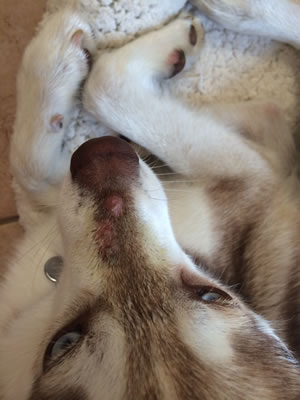
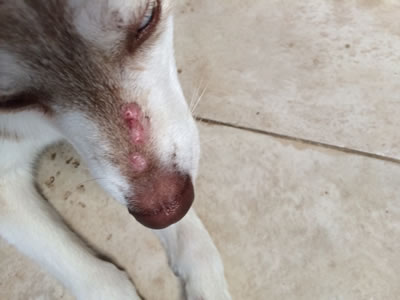
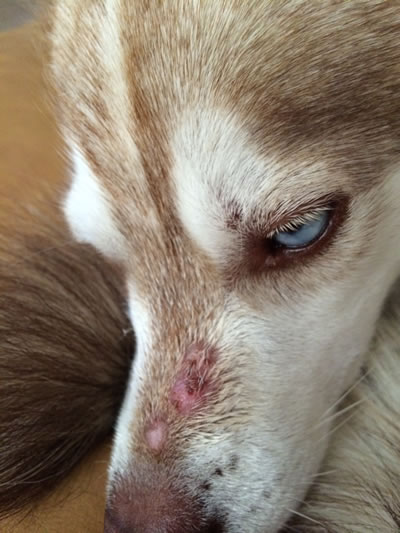

(Mpls., Mn)
09/02/2014
Hey Mandi!
What a cyootie patootie! I cannot tell if he is a Siberian or an Alaskan Klee Kai, but I can see for sure he is a beauty!
That does not look like demodex; 'ringworm' comes to mind but it doesn't look like your typical ringworm.
If this were my dog I would: scrub the whole muzzle, not just the affected sores and get any crusty, scabby skin off the sores while working at it. The anti-staph/anti-fungal solution would be a good choice to use after the washing/scrubbing is complete; you want to flood the entire area with the solution and really saturate it down to the skin. I would also consider using an OTC tripple antibiotic ointment on the sores. Try flooding the muzzle with the solution every day for 3 days in a row, and try applying the antibiotic ointment twice a day for the next three days and then report back.
(Dallas, TX)
09/02/2014
Hey Theresa!
wow you know your dog breeds! Not many recognize an Alaskan Klee Kai :) he's 16 months old, .. Full grown! He is a cutie pie , thank you! Hoping he won't have permanent scarring, where the first sores were they have healed but left a pigmentation mark but that's the least of my concerns ;) I've used the mange cure 3 nights in a row and it seems to be working! He has no open sores anymore and the one I thought was going to erupt seems to have stopped with the cure ( it didn't erupt, turned the skin whitish). I will make the other remedy and apply it tonight instead. I don't think he needs the antibacterial ointment because there's no open sores but I'll get some jic. He gets lots of good supplements, including garlic and Vit C and especially for the skin issue he's getting homeo Sulphur and ledum palustre. I'll report back in after a few days And send a pic. Thank you so much for all your help to us and for helping so many people and animals! May many many blessings return to you all for your service! :) do you all accept donations? I'd like to offer something in exchange for your time/ energy.
Thanks again, Blessings, Mandi & Tiko :)
(Mpls., Mn)
09/03/2014
(Dallas, Tx)
09/17/2014
Hello Theresa,
hope you're doing well! Thanks again for all your help! I submitted a couple of pictures of Tiko. I added the Epsom salt and MOM as you suggested to the h202 and borax and applied it every night. It has worked beautifully. His fur is growing back in and all that is eft are the pigmentation marks from the sores. I stopped applying it just two nights ago. Do you think that's ok ? Or should I keep it up for another few days just in case?
Blessings, Mandi
(Mpls., Mn)
09/19/2014


(Mpls., Mn)
09/19/2014
Borax and Peroxide User Reviews
We haven't seen Mika for the last four weeks - then my daughter tells me that Mika is pulling her fur out. I went to see her and Mika's coat is looking thin and her belly is red and sore looking. I suggested that my daughter take Mika to the vet. I took Kody to the vet. The vet took a nit comb down Kody's back and announced that it wasn't fleas. The vet looked at Kody's stomach, which is mainly a beautiful healthy pink but had about half a dozen red spots and a couple of black head-looking spots on it. The vet announced that Kody had a bacterial infection and prescribed anti-biotics. I
was concerned about Kez getting this and the vet said it wasn't contagious (I thought anything bacterial was contagious?). Kez has nothing - no itching, no red spots. Kody has been on the anti-biotics for a week now and has a week to go but she's getting worse. Now she's nibbling at herself and has broken the skin in a couple of places. She's mainly nibbling her legs, sides and thigh but she's still scratting at her neck and ears. Given all this info could anyone tell me what they think this is? Kez has no symptoms whatsoever - but then she avoided Mika and, although Kez and Kody get on really well, they don't contact so much with each other physically. Mika and Kody had very close contact - laying on each other and play biting each other a lot.
Today I'm going to start this borax and H2O2 treatment on Kody because she's getting miserable with this. I was going to take her back to the vet but my trust in vets, particularly after the last visit and after reading this forum, isn't so high. Kody is a healthy and strong dog, I can't think that her immune system is low because she's generally very healthy but I'm going to get her the supplements suggested on here anyway because she's had the anti-biotics.
Any ideas from anybody would be appreciated - I'm not sure what I'm dealing with and given that skin scrapings are so unreliable, by all accounts, I don't want to go down that road. I certainly don't want to use toxic chemicals on an otherwise very healthy dog. And I'm dreading the thought that Kez starts to itch because she's a rescue (four years ago) and isn't as easy to deal with as Kody who I've had from a pup. Kez is old and has arthritis and hates to be messed with - should I treat Kez "Just in case" or wait and see what happens? My gut says treat them both but I don't want to put Kez through unnecessary stress :-(
(Mpls., Mn)
08/30/2014
Hey Paula!
I have to say, that I for one have an excellent relationship with my vet, he doesn't scam me, isn't in it "just for the money", has talked me out of expensive tests that I insisted I needed [he was right, I didn't need them] and has always been fair with his pricing and when I thought things were expensive has always explained the bill in detail so I could see all fees charged were reasonable. Even if I don't like paying expensive vet bills, they are part of owning a pet and not all vets are crooks. So if you had a good relationship with your vet please do not let other's poor experiences change the way you relate to your vet.
Now, it is entirely possible your dogs have scabies mites; this is a contagious form of mange and as you already know, skin scrapings by their very nature can be hit or miss. If these were my dogs I would treat all three with the mange remedy. Do it twice the first week, and thoroughly clean and launder all bedding. Keep this up once a week after the initial 2 dips for another 6 weeks.
Also, alkalizing may help if what you are seeing is NOT contagious and just a huge coincidence that the Dodgy Dog did not give your dogs a bug; it is entirely possible all three are dealing with allergies. So try this; 1/2 teaspoon of baking soda into 1 liter of drinking water, this as the only drinking water for 5 days, then drop down to 1/4 to 1 liter as a maintenance dose. When my dogs go through an episode of itchies I do this with their water and take it myself! If the dogs are reluctant to take the water I will do 1/4 into 1 liter for the first 2 days and then bump it up to 1/2 for 5 days and then drop down to the maintenance dose for 2 weeks. I don't keep them on the baking soda all the time, but during allergy season I will dose it 2-3 times a season.
(Yorkshire, England)
08/30/2014
Hi Theresa, thanks for replying. I do worry that vets sometimes treat animals for the wrong reasons, I wish I had a vet like yours :-). Both of my dogs are insured anyway so the bills don't bother me. My main concern is to avoid the toxic chemicals for all the dogs - the vets would have it otherwise.
I can't quite pin the symptoms on sarcoptic mange as it generally starts on the ears and face apparently and I can't see any hair loss at all on Kody - I can see, with my overly paranoid gaze, thinning of her fur on her thighs I think. It can't be demodectic because apparently that isn't contagious outside a litter situation. Kody only started nibbling at her legs and thighs yesterday.
I can't hurt her with this treatment can I, that's what I'm bothered about. Neither dog can live like this so something has to be done. Hopefully this borax and H2O2 treatment will sort it. If not then it's back in the hands of the vet but I'll be worried sick about the toxic treatment.
With the Borax and H2O2 treatment I gather that the situation will initially appear worse as the die off starts? I'm figuring that if it does get a little worse then it confirms that it is actually mites. Do you think that's so? And if it's been a flea bite allergy would it go on this long once any fleas that may have been on her have gone?
I've put the sodium bicarbonate in their water with a little borax as someone else suggested (I've taken this myself so I know its ok). I'll let you know how we get on.
(Mpls., Mn)
08/31/2014
Hey Paulaj!
My experience with sarcoptic mange/scabies is that it starts where it starts - no starting on the ears and face [text book for demodex] rather it just starts where it can - AND can be super tricky for your vet to figure it out until the situation becomes extreme, and thus readily apparent as to what the problem is.
The borax/hydrogen peroxide solution is not toxic, does not have an accumulative effect in the body at the cell level, and is effective. I have used it literally hundreds of times - it is my first "go to" when I see any skin issues in my pack. And it is not that I suspect each time I see a skin issue that it is the result of a parasitic mite, rather the solution has a broad spectrum appeal so covers mites and bacteria and yeast.
If it gets worse after application it could be mites - but without confirming with a microscope cannot be sure. And flea allergy simply means that your pet was exposed to fleas at some point in their life and developed an allergy to their bite; even if the environment if free of fleas, if on a walk your dog get's bit, then it will react accordingly.
One thing I do know is that dogs of any age can develop allergies to all sorts of things that they had no problem with prior. Perhaps your dog now has a grass allergy, or a pollen allergy. You sound like you are savvy on your critters so likely feeding a top diet, grain free kibble or RAW - but do check the ingredient panel and consider shopping around if you have been feeding the same brand for a number of years. Some find switching protiens to be of great benefit for dogs with food allergies, so they feed a beef diet one week [or one bag] and a fish diet the next, and then on to poultry, then pork, then venison, then duck - and so on.
I do think you are on the right track with alkalizing the water. Do try the dipping solution for the entire dog and consider doing it daily, right after your walk, on just the affected areas.
(Yorkshire, England)
08/31/2014
Has anybody's dog thrown up while being treated with borax and H2O2? I know I got the solution right - no doubt about that. It could have been the situation, Kody's never been in the bath before - I usually do her in the shower. She vomited three times - yellow bile (luckily she hadn't yet had her breakfast). She's absolutely fine now but I just wondered.
(Mpls., Mn)
08/31/2014
(Yorkshire, England)
08/31/2014
She only ingested it in as much as she could lick off her shoulder as it ran down before I stopped her, she didn't lap from the bath. It must have been the unfamiliar situation, that and being lifted in - I think that's the first time she's been lifted since she was a pup. She's a bit of a sensitive lump is our Kody :-), big dog and beautiful temperament. She's almost dry now, all dusty white looking but she's happy enough. She's only scratched twice since her bath but I expect that's because she's cool being damp.
I'll do as you suggest and get her most obvious problem areas done again tomorrow. I'll sponge soak her outside I think, might be easier and less stressful for her (and me, it didn't do my back much good lifting her out quick to avoid her getting covered in the floating yellow goo she'd deposited in the bath). She has a black tipped topcoat so I expect that will turn colour as we progress but her black will come back won't it. I hate to see her so miserable with this horrible itching, I really hope this works.
(Raleigh, NC)
09/01/2014
Hi Theresa. I want to tell you about Bailey. I started giving her the borax, but I don't know if it is normal, she was with diarrhea. So I stopped and started her with the baking soda, and spraying her with the solution you told me. She is doing much better. Thank you. Something else - what is the best food for her. She needs grain and potato free. Do you know a good brand, Now she has her mammary glands really swollen. I am giving her coconut oil with turmeric once a day. What else can I do for her. Thank you for helping us and our pets.
(Mpls., Mn)
09/02/2014
Hey Nayibe!
The best food is the one she does the best on - there is no one brand I can suggest as it is an individual thing. I like to use the dogfoodadvisor.com website to search out different brands, and I try to feed only the top ranking diets. There are entirely grain free and potato free diets; one well respected diet that fits your criteria is 'Origen' - some people report great results feeding this diet, however I wasn't happy with the results for my pack; I suspect they need a bit more fat and more carbs due to our harsh winters. Again, this is for my dogs and you may have completely fantastic results feeding Bailey on this diet. One word of advice - since grain free diets are very concentrated you need to feed less, meaning if you normally feed 1 cup of grain/potato/meat kibble you should start off by feeding 3/4 cup of the meat based diet. If you see loose stools this is often the result of feeding too much of a calorie dense food, so try cutting it down to 1/2 cup, etc.
Keep an eye on the mammaries and feel around; *hard* lumps that feel like dried peas can be cancer, while extreme tenderness around a swollen knot could be mastitis.
(Raleigh, NC)
09/02/2014
(Hope, Bc Canada)
09/02/2014
Hi Theresa --- You probably know it but here for visitors to the EC site BEES KNEES mite spray.
This was from the poultry keepers blog which I visited just to make sure I am missing something. After reading a long column of woes, I sent them my condolences with a remark, here on EC sometime ago that a grandmother had yearly put lard under the wings of her flock. With success because she did it every year. Wish my dog had wings.
My big hound has probably red mite infestation. But as with all mites, they defy everything but nuclear fission. Last year I treated it with orange cleaner essential oil. Now, in the heat, it is back. They are all over the world; just read up and it raises ones heckles. They increase in the millions and invade house and home.
I treated my boy with Ted's but with his water dog fur it slides all off and it is worse thence. I have a little ten pound Maltese with mites. Easy to do but no noticeable results and with the treatment he looks like a toothbrush now.
As with my own mites, I have them sort of under control by means most people may not believe in. But they do make a difference. Firstly, mites do jump. They did from the used pillow I used once. Slowly my hair lost its beauty and I am still fighting the invasion in face and hair. Luckily, not the rest of my body. One poster on EC said that a green Led light would get them out of the eye socket and ears. Mine are invisible.
So, what I use is a mixture of Palma Christie (cold pressed castor oil) and VCO. If it does not go into the eyes one can add an essential oil to the mix. But even without essential oils, the eyes do well because they are killed evidently because of the "sleep" around the eyes.
Other posters in the past had mentioned the applying of ones saliva when the tickling is first noticed. This is very effective, I must agree. After application, no more bother. This points to the body's defensive mechanism designed for the individual constitution. This then leads to my no.1 weapon which is urine therapy (UT). This is the blueprint of ones own individual condition creating the anti bodies for everything out of balance. I use a washcloth and rub my face well with the result of very fine, perfect complexion and it is as good in the eyes. This what has helped a lot. Also the hair, which can be rinsed after half an hour or so. Being vegan the scent is very delicate and pleasant.
On the list is still flowers of sulfur, homeopathically as well. Added to which raw veggies processed and the only exception of grains is barley for our friends.
So, the Bees Knees is a number of toxic essential oils , clove, cedarwood (not for cats) rosemary, lavender. NEEM OIL interrupts the breeding cycle. These are all toxic to mites. Twenty drops of each one tsp of liquid soap and fill the spray bottle with water. Shake.
This is not inexpensive but has helped some.
Even our feathered friends have a lot to suffer from. Namaste, Om
(Mpls., Mn)
09/02/2014
(Lapel, Indiana)
12/17/2014
I was wondering the exact measurements of one bath? I have two pups, one 10 week old and one 8 month old that I want to treat together to make sure its out of the house! I know the protocol called for a liter of peroxide and a half liter of water with 3 tablespoons of borax. Is this correct for one bath? Thanks!
(Mpls., Mn)
12/17/2014
Hey Kelsey!
The amount needed for 1 bath is the amount needed to fully saturate both your dogs to the skin!
I have a quantity of dog/s and this remedy is my 'go to' when any sort of skin issue arises; I have also used it to successfully resolve demodectic mange in a puppy.
What I do is get an empty plastic 1 gallon jug so I can mix up a big batch. I get 1 brown bottle [16 oz] of 3% peroxide from the grocery store - and I pour that into the jug. I then use the empty brown bottle and fill that up twice with water and dump that into the jug with the peroxide. This gives me 48 oz of a 1% solution of hydrogen peroxide. I then add 1 full cup of borax [from the laundry aisle at the grocery store - plain, not scented] and shake it up. What you want is there to be so MUCH borax in the jug that it stops dissolving, leaving grains swirling around in the bottom of the jug. If you have a big dog you can use two jugs and mix up a super big batch - just make as much as you have dog.
What I then do is fill the bath tub with warm water and sit the jugs in it and let them get warmed up. When the water is just right I bathe my dog with regular shampoo and rinse well, making sure I use my hands to squeegee excess water off. I then plug up the tub when it is empty, and them pour the solution from the jug over the dog. I then use a plastic cup to scoop up solution from the bottom of the tub and pour it over the dog again and again for 20-30 minutes. I have done 2-3 dogs at a time to make the most of the solution. I then crate the dog in an empty crate - no bedding to absorb the solution - and let the dog sit in the crate with a chewy for another half hour so the solution can continue to work. After half an hour I let them out, towel them dry and brush the grains of borax off of the fur. You may want to bump up the temp in the house or put the dogs in a room with a space heater so they do not take a chill.
I use the dip for mange every other day for a total of 3 dips for the first week, and then once per week for a total of 12 weeks.
Good luck!
this is the formula I used:
1 16 oz brown bottle of 3% solution hydrogen peroxide from grocery store.
I dumped that into a jug and then added 2 bottles of filtered tap water using the now empty brown bottle from the hydrogen peroxide, giving me 48 oz of 1% hydrogen peroxide solution.
1 16 oz brown bottle of 3% solution hydrogen peroxide from grocery store.
I dumped that into a jug and then added 2 bottles of filtered tap water using the now empty brown bottle from the hydrogen peroxide, giving me 48 oz of 1% hydrogen peroxide solution.
Now, into the jug full of 1% solution I add 1 full cup of borax [from the laundry aisle at the grocery store]. Shake it up - there should be so MUCH borax in the solution that some grains remain and do not dissolve.
I then fill my bath tub with very warm water and set the jug in the tub; by the time the tub cools down enough to comfortably bathe the dog, the contents of the jug are nicely warmed also. Now bathe the dog with the shampoo of your choice and then rinse all the shampoo out. I drain the tub and when all the shampoo and water have drained, I plug it up again so it will again hold water. Then I shake up the solution in the jug and pour it all over the dog. I then use a plastic cup to scoop up the solution in the bottom of the tub and then pour that over the dog. Do this again and again, re-wetting the dog with the grainy solution, for at least 10 minutes. Next part: do NOT rinse the solution off the dog. Take your sopping wet dog and put him in a crate with no bedding; you want as much solution to remain wet on the dog while he sits in the crate - give it another half an hour in the crate to allow the solution to 'work'. After half an hour I let my dog out and towel dry, and then let him shake the grains of borax out of his coat. It helps to turn the heat up in the house so the dog isn't freezing while sitting wet in the crate. I have doubled the batch of solution simply because its so inexpensive and it makes it easier to saturate a big dog.
You should dip your dog in this solution every other day - 2 to 3 times the first week; after the first week do once per week for 8 weeks.
(Mpls., Mn)
12/17/2014
Hey Kelsey!
It occurred to me that you might have Chihuahuas and might not need 48 oz of solution :-)
The formula is this: 1% hydrogen peroxide + borax - you keep adding the borax until it stops melting/dissolving in the solution. This is called a 'saturated' solution where the liquid can take no more of the borax so it stops dissolving. As long as you add borax to the point that it no longer dissolves you don't need to worry so much about measuring it.
You make a 1% solution from the brown bottle from the grocery store - usually a 16 oz bottle of a 3% concentration of hydrogen peroxide - by adding 1 part hydrogen peroxide to 2 parts of water. So 1 cup of your 3% brown bottle solution to 2 cups water and you now have 3 cups of a 1% solution of hydrogen peroxide - and to this you add the borax.
Hope that helps!
Borax and Peroxide User Reviews
★★★★★
Borax and Peroxide User Reviews
So our 5 month old French Bulldog puppy got diagnosed after a scraping with demodex, and it is generalized. We have about 6 1-2 inch spots on her trunk, in front of both ears, middle of face, a big patch on back leg, large patches on front chest with consistent red bumps and pustules.
After all of my research and wanting to give her immune system the best chance at battling it off before using chemicals, I have put her on an great diet (no starches, grain free NutriSource), Nupro supplement, alaska fish oils, and more probiotics with a teaspoon of melted coconut oil on top.
I started doing the Ted's remedy baths exactly a week ago and have have done it three times this first week. I am hoping what I describe is a part of the healing crisis and would appreciate any insight:
So her spots started bald and after doing Ted's remedy once or twice, big red bumps and pus bumps/pustules started popping up in the bald spots only. In between Ted's treatments, I clean with povidone iodine twice a day and have mixed my own neem, lavender, tea tree oil in almond and vita E oil that I put on her at night.
So after a week, the red bumps are on all the previously smooth bald spots and open up, or turn pussy, but they are drying out even though they keep popping up.
I am assuming this is the onion/layer/healing crisis since demodex is so deep in the follicles and takes time to kill at the deepest source. And her skin is turning a darker color (almost purple). Is this normal to expect during the healing crisis? I know treatment of mange takes a while, but it's killing me to see her with so many red bumps/pustules.
Her energy levels are great, she plays/wrestles with our other dogs, eats well and is happy - no change in energy.
Any insight or experience with something similar would be great to hear - or if it sounds like I should take her in and give in to the chemicals (I DON'T want to do this since she's so young).
Thank you!
Lexi
(Mpls., Mn)
08/25/2014
Hey Lexi!
IMHO what you are seeing is normal. When the mites experience a massive die-off, their decomposing bodies that are deep in the follicle release highly irritating toxins, resulting in the pustules that you are seeing.
You might consider using Ted's Anti-staph/Anti-fungal remedy to stack the deck against a secondary infection to the traumatized areas.
Take 1/3 cup of hydrogen peroxide [the bottle contains a 3% solution] and add 2/3 cup pure water; this gives you 1 cup of a 1% solution of hydrogen peroxide. To this add 1 teaspoon EACH of: Epsom salts, Borax, and Milk of Magnesia. Blend well until all crystals have dissolved and apply to the affected areas. This has a 'working' effect for 24 hours; you can apply daily or as needed.
(Alaska)
08/25/2014
(Mpls., Mn)
08/26/2014
(Alaska)
08/26/2014
Thanks again for getting back! I just applied the mixture you supplied and we'll see if that helps!
She is mostly red, but has a black mask, but striped with white on her face, white chest, white belly and a few white spots on the top of her neck Everything else is red, except the slight black mask on her muzzle and ears.
She does have varying skin colors where she's hairless on her belly and it ranges from white to dark purplish. The infected spots that are turning color were first much more white and now are turning the purple color like what's on her belly. And they're turning darker on both the red and white parts of her body....hmmmmm, so after reading about black mange or hyperpigmentation being a bad sign, it got me worried that maybe this natural remedy isn't working! But her skin is flaking away where old bumps used to be, which to me is good!
I know beating this is a patient game and I'm just not that patient. :)
Thanks again,
Lexi (& June Bug)
(Mpls., Mn)
08/27/2014
Hey Lexi!
What you are describing sounds like normal pigmentation for a pied -and sounds like you have a very pretty black masked fawn pied. In dogs where the skin turns dark from allergy, they are typically much older and have a history of allergy. I find with frenchies that the first year - demodex aside - tends to be fairly problem free, but the second season hits with a vengeance, and any allergies that did not appear in the first year manifest during the second.
One other thing you can do that may help/help a lot/certainly won't hurt - is alkalizing by adding baking soda to her water. There are two doses - 1/2 teaspoon into 1 liter of water, this as her only drinking water, for 5 days; the maintenance dose is 1/4 teaspoon of baking soda to 1 liter of water. When I notice that my pack of frenchies are starting to get the seasonal itchies, I do the crisis dose for a week, then drop down to the maintenance dose for another few weeks. I also take this myself while I treat the dogs ;-) So, this may help with the current demodex situation by balancing your dog's PH and thus making her less attractive to the demodex mites.
(Alaska)
08/27/2014
★★★★★
Thank you again, Theresa!! I can't tell you how valuable your feedback has been and how great that you too have Frenchie experience!
Did you find that if you let a female go into heat after having demodex as a puppy that she had another outbreak (or were the allergies that manifested the second year come after a heat)?
I will try the drinking water fix as well, thank you!
I can tell you that her itching flat out STOPPED last night (first night ever without itching!! ) and I had applied that anti-staph/yeast solution earlier in the day.
I will write again hopefully when she's fully recovered, but so far, Ted's remedies (and your faithful help) are curing little June Bug!
Thank you,
Lexi
(Mpls., Mn)
08/27/2014
Hey Lexi!
I originally found this website because my brindle pied frenchie had demodex. The littermates had it also, but I was the only puppy person to go 100% drug free/wholistic in treating my puppy. The other puppy owners used Ivermectin and other drugs and out of them all my puppy healed up the fastest using Ted's Remedy. I find that after the first episode of puppy demodex that it does not return; should it appear in an adult dog it usually happens due to an underlying disease condition, or a very stressful event.
I find that for allergies, if you are going to be allergic to something, you need to first be exposed to it; this is where your immune system decides if it is friend or foe. Upon the next exposure the immune system has decided friend or foe and reacts accordingly. So, the first year your puppy may appear to be free of the seasonal allergies that affect so many frenchies - but next year, when the allergens are again exposed to your pup, the immune system will have an opinion, and you may find that your pup is sensitive to grasses or spring pollens or fall pollens or the mold that occurs during the spring melt off on your lawn.
Please keep us posted on June Bug!
(Alaska, US)
08/28/2014
Hi again!
I need some encouragement in keeping the faith with these natural remedies...
So I was curious how long it took your Frenchie pup to recover from mange using Ted's remedy (and how bad was yours)?
Also, how long does the healing crisis last ... I know it is supposed to get worse before it gets better but it seems like it's spreading (I'm guessing that the mites are angry and moving from a previously infected spot to a new one close by??)
Just trying to manage my expectations!
Thank you! Lexi
(Mpls., Mn)
08/28/2014
Hey Lexi!
Demodex typically takes months to resolve. I want to say my puppy took 12 weeks of treatment. She had generalized demodex according to the definitions, but I think the definitions are kinda screwy, ie if on the face only it is localized. Mine had spots on the face, on the legs, on the trunk - more than 6 that I recall; I am wishing now I took photos! I gave her 2-3 baths the first two weeks and then weekly thereafter. Mine got worse before it got better, so much so I ordered a bunch of other remedies *just in case*. By the time the other remedies arrived in the mail I could clearly see the remedy was working after all, so I did not use the additional remedies I had purchased. If I had to recommend a second remedy, I would mix up sulpher flowers in castor oil and apply that to the spots... but I really think you should hold off on and just wait one more week.
There appear to be some species or strains of demodex mites that do not respond to this remedy. However make sure you are doing it right; making a saturated solution by adding so much borax that the grains of borax do not fully dissolve; treat the entire dog, not just select parts; dip your dog in the solution for at least 10 minutes straight, working the grainy solution down to the skin, and then put in a crate with no bedding and allow to drip dry for half an hour - after that I let them out and towel them off and work the grains of borax out of their coat; it is like they run around the house leaving 'sand' all over when the dried borax falls off.
It sounds as if a secondary staph infection may have set in; if you wish to stay with the holistic as opposed to getting antibiotics, use the Staph remedy daily if not twice daily. Boost immune system with Vitamin C, Echinacea and Zinc. It is advised to keep demodex dogs calm and stress free, however I am not sure that is possible with a 5 month old puppy.
Was your puppy on a regular worming schedule from the breeder? Being parasite free on the inside will help.
It is not likely that the mites are migrating to infect new spots, rather, the populations of mites were already present in what appeared to be unaffected areas and the treatment is causing those populations of mites to die, and the decomposing bodies of the mites are releasing toxins which are irritating, causing the itching, redness and pustules.
(Alaska, US)
09/01/2014
Thanks again, Theresa!
When I got her, she did have worms (the breeder had her on an OTC mild puppy wormer). I noticed her stools were mucousy and sure enough, when I looked closer, there were tapeworm segments. I got a strong, broad spectrum dewormer (one dose) from the vet and she passed dead tape worm segments and one HUGE roundworm. I wonder if that dewormer/chemical made her immune system even more susceptible??
Anyway, now she's worm free, but demodex full. :/
I am definitely making the remedy right and I keep her in the sink and keep squeezing it over her skin for about 20 minutes each time and let her air dry. Her oldest spots seem to be getting better - at least they're not continuing to have new red bumps/pustules. But other spots have lost more hair/spread and are all ridden with the red spots and little pustules.
I am doing the anti-staph (really dries it out) and I recently discovered Homeopet First Aid ointment (has all sorts of great things in it, echinacea, sulphur, chamomile, etc. in mineral oil) and that is helping quite a bit.
It's just tough keeping the faith during this healing crisis. If yours had the healing crisis/die off effect, how long did it last?
And should I keep doing the aggressive Ted treatment (3x/week) for more than two weeks? Or what should be my indicator to back off to the once/week schedule?
Thanks again! Lexi
(Alaska, US)
09/01/2014
Thanks again, Theresa!
When I got her, she did have worms (the breeder had her on an OTC mild puppy wormer). I noticed her stools were mucousy and sure enough, when I looked closer, there were tapeworm segments. I got a strong, broad spectrum dewormer (one dose) from the vet and she passed dead tape worm segments and one HUGE roundworm. I wonder if that dewormer/chemical made her immune system even more susceptible??
Anyway, now she's worm free, but demodex full. :/
I am definitely making the remedy right and I keep her in the sink and keep squeezing it over her skin for about 20 minutes each time and let her air dry. Her oldest spots seem to be getting better - at least they're not continuing to have new red bumps/pustules. But other spots have lost more hair/spread and are all ridden with the red spots and little pustules.
I am doing the anti-staph (really dries it out) and I recently discovered Homeopet First Aid ointment (has all sorts of great things in it, echinacea, sulphur, chamomile, etc. in mineral oil) and that is helping quite a bit.
It's just tough keeping the faith during this healing crisis. If yours had the healing crisis/die off effect, how long did it last?
And should I keep doing the aggressive Ted treatment (3x/week) for more than two weeks? Or what should be my indicator to back off to the once/week schedule?
So I wanted to specify how much worse it's gotten after 2 weeks of Ted's remedy 3x/week:
Existing spots are all red, bumpy and have pustules.
New spots have popped up - her biggest area on her chest is spreading down her entire arm to her toe. Three new separate spots have popped up in independent areas, and the spot on her head is spreading as well.
Does this sound normal? Or should I be worried her mites aren't reacting to Ted's remedy?
So far everything has gotten worse...some of her older spots may be getting better - they don't have as many red bumps and are darker in color. But other than that, it's spreading and new spots are popping up (all with red skin and bumps.)
I'm just feeling anxious...ah!
Thanks, Lexi
EC: So I wanted to specify how much worse it's gotten after 2 weeks of Ted's remedy 3x/week:
Existing spots are all red, bumpy and have pustules.
New spots have popped up - her biggest area on her chest is spreading down her entire arm to her toe. Three new separate spots have popped up in independent areas, and the spot on her head is spreading as well.
Does this sound normal? Or should I be worried her mites aren't reacting to Ted's remedy?
So far everything has gotten worse...some of her older spots may be getting better - they don't have as many red bumps and are darker in color. But other than that, it's spreading and new spots are popping up (all with red skin and bumps.)
I'm just feeling anxious...ah!
Thanks,
Lexi
(Mpls., Mn)
09/02/2014
Hey Lexi!
After re-reading all your posts and updates, to me it sounds like June Bug has a systemic bacterial infection going on and very likely needs antibiotics. The remedy is working on the mites, but the secondary bacterial infection is fighting from the inside out, so the topical solutions will only work so far. You can go the 100% natural route and possibly avoid dosing antibiotics, but I think you would have an entirely bald very unhappy dog if you do down that path.
If this were my dog I would throw in the towel and see the vet. They will prescribe an antibiotic, which IMHO is appropriate; this means stopping the probiotics for the duration of the antibiotic treatment [2-3 weeks]. They will prescribe an antimiticide such as daily oral Ivermectin which is a human drug; at this juncture I consider dosing it for 5 days. I would NOT use Amitraz dips, which are both spendy and IMHO highly toxic, or Milbemycin Oxime.
I would additionally consider worming her for roundworm at least 1 more time if not 2-3 more times as the worming schedule you outlined was not sufficient for roundworm.
I know you are feeding good groceries but you may wish to try RAW or switch to a diet that has zero grains and potatoes to help starve the mange mites from the inside out. I would consider adding 500mg vitamin C and echinacea to the mix am and pm. I would also consider using homeopathic Sulpher.
I would back off on the dipping in the remedy to 1x week, and consider doing a essential oil of lavender and Neem oil rinse on the other days to help calm the skin. The Homeopet salve sounds like a winner, and I would use that on the spots that ask for it or the home made combo you were using prior.
(Alaska, US)
09/02/2014
Thank you as always, Theresa...they have a gem in you!
I threw the towel in this morning after feeling June Bug's very enlarged lymph nodes under her jaw late last night and after reading your post this morning...
Loved my vet today (new vet). After a "taping" of all her spots, it came back exhaustingly (depressingly) positive for staph and cocci. She prescribed dewormer (2 doses over the next 2 weeks) and antibiotics only and told me to keep at the supplement immune building, the benzoyl peroxide/sulfur/salicylic acid baths with my DermabenSS shampoo (but not more Ted's for a week at least). She didn't want to do any Ivermectin until we got the secondary bacterial infection under control. I really respected this...she said she wants to get the discomfort under control and give it a few months before we put the anti-miticide chemicals in her. So after I get the bacterial infections under control, she wants me to try again with Ted's.
I have been feeding a no grain/no potato food source (NutriSource kibble) with Alaskan fish oils (live the closest to it! ), coconut oil and probiotics along with all immune building supplements.
And because I've done the lavender/neem/tea tree, etc., we decided with the antibiotics to keep things simple and only treat skin topically with coconut oil.
I will certainly keep you posted and thank you again for all your help...it has been much appreciated and I hope our conversation can help someone else!
Forgot to mention that the taping results came back negative for yeast, which is a relief in some way. At least we're just battling bacteria...!
Lexi
(Mpls., Mn)
09/03/2014
(Alaska)
09/05/2014
Hi there,
So we're on day 4 of antibiotics and things are already looking a bit better.
However, my gut is saying that I shouldn't take a break from treating the mites or I am losing precious time since I do believe I was going through a major die-off.
I think the hydrogen peroxide mix was too irritating and read that there is a Ted's version using apple cider vinegar as the borax carrier...if this is correct, do you have a recipe for that? And experience with it?
Thanks again!
Lexi
(Mpls., Mn)
09/05/2014
Hey Lexi!
I agree with you, but not sure you need to act *now*; I think you could hold off a few more days to allow the skin to heal. How many treatments with Ted's remedy did June Bug get? 2-3 the first week, and then once per week up until just a few days ago?
You only need to dip once per week - this in keeping with the life cycle of the mite. Can you follow this up with a moisturizing bath/treatment an hour or two after the dip? I would suspect with her skin healing up now that the secondary bacterial infection is being treated, her skin would be less irritated with the 1% hydrogen peroxide.
I have not used the recipe with vinegar, although I know I read about it - I just can't find it, particularly now that everything seems to be sorted out ;-). What I have read - what I could find - is that vinegar is likely to be far more irritating/will sting. I have used the solution with cuts on my own hands and also done vinegar rinses on my dogs and the vinegar does sting the raw skin whereas the 1% hydrogen peroxide did not -this from my own personal experience.
All that said I was able to find this for you:
Posted by Kc (Newtown, Ct) on 04/05/2010
[YEA] It worked!!! Thank you Ted! I was so stressed out when my dog started to show signs of mange. I made this remedy using 1 part Apple cider vinager (AC vinager instead of peroxide because I didnt want to "highlight" her black fur) to 2 parts water, and added borax laundry detergent until it wouldnt dissolve anymore. I put her in the tub and splashed on the solution until she was soaked, no gloves needed. I used a cottonball for around her eyes. I then washed every pillowcase, blanket, and rug that I could and sprinkled the borax powder all over the rest including the couch. Left that overnight and vacumed it up the next day. It was winter outside and I admit it wasnt fun for anyone to have a soaking wet dog running around, but it was worth it. Immediately the itching stopped. Within the first few day, I could see improvement. I did this intense house cleaning and borax soak with her once a week for 4 weeks and In 5 WEEKS it was completely gone! Thank you thank you thank you. Super easy, SO MUCH HEALTHIER, and wicked cheap!
- See more at: https://www.earthclinic.com/pets/dog_mange_cure7.html#sthash.47KmmrB8.dpuf
(Alaska, US)
09/05/2014
(Alaska)
10/24/2014
Hi Theresa,
So I wanted to post an update on June Bug. We had her on antibiotics for about 5 weeks which helped a lot, continued to do Ted's during the first 3 weeks of antibiotics and then I just backed off and stuck with benzoyl peroxide shampoos 2-3 times a week.
I also did a grain free diet, Standard Process Canine Immune Support supplement, Alaska Fish Oils, NUPRO supplement and sardines annnnnd...took her in for scrapings a couple days ago and all of the spots came back negative for mites! They only saw a few from 2 scrapings on her face, but it looks like we are winning the battle doing it all naturally (aside from the antibiotics)!
Her skin was pretty ravaged by the mites (BIG blackheads in some spots and little superficial blackheads all over the previously affected spots and I'd say she lost 30% of her hair all together), but hair has started growing back at a fast pace these last couple of weeks.
I almost gave up multiple times and went with Ivermectin or some other chemical, but so glad I stuck with Ted's and the immune building diet protocol! It can work, and it has been for June Bug.
Thanks again, Lexi
(Ct)
11/19/2014
My husband doesn't believe in bathing dogs so our Lab/mix has only had 2 or 3 in the 7 years since we rescued him. So, here we are in 20 degree weather, so I can't bath outdoors; how do you even get a 60 lb lab in the tub and get him to stay there so you can treat his skin; it started on his face around his eyes and itchy ears and then spread to his belly and between his foot pads; he's constantly scratching/chewing......suggestions? Carla
(Ma.)
11/20/2014
★★★★★
I used to bath my huge pit bull in a plastic or tin or even metal portable big tub, you might be able to buy at either Lowes or Home Depot another time we used a kids plastic swimming pool, then we either did him in the cellar or put a huge absorbent blanket in the kitchen and try to wash him/her.
Good Luck & have fun. :-)
(Mpls., Mn)
11/21/2014
Hey Carla!
Have you taken your dog to the vet for a diagnosis? Demodectic mange in a 7 year old dog usually means something deeper is going on. Sarcoptic mange is something your dog can catch from wild animals, and would require his entire living space to be decontaminated to avoid catching it again. However what you describe could also be allergies, which commonly develop in dogs as they age.
As for bathing options, it certainly would be good to start with Ted's mange dip to see if the itching your dog improves. There are places you can take your dog that offer grooming services and some offer DIY dog washing space. Check out your local [and often big chain] pet food stores to see if they offer grooming or DIY dog washing.
Additionally, what you feed your dog can make all the difference; if you are feeding Ol' Roy or Purina then a grocery upgrade is needed; look for grain free diets and expect to feed for 6 weeks before you see improvement. Consider adding probiotics - good bacteria - in the form of yogurt or capsules from the refrigerator section of the health food store.
Lastly, consider alkalizing your dog's drinking water. Add 1 teaspoon of baking soda to 1 liter of water and have this as the only source of drinking water for your dog. Mix it up fresh and only offer when the baking soda has stopped fizzing. After 1 week you can reduce to 1/2 teaspoon of baking soda, and after 2 weeks you can reduce to a maintenance dose of 1/4 teaspoon in to 1 liter of water.
Borax and Peroxide User Reviews
Vet diagnosed demodex and gave Advocate - every 2 weeks for 6 weeks, then monthly for few months. This improved demodex. Went onto raw diet (sorted continence issue - she is too small to contain the bulk of non-raw food needed to give her enough energy! ). Eyes I realised over time have many issues - allergy, dry eye (I think from demodex?), getting things in her eyes because she is so small (I now flush them with saline 3 times a day; sometimes she has rocks in there..and use Optimmune - tried everything natural can think of but this seems to help most as she no longer gets really sticky lumps on her eyeballs).
She still, though, had residual signs of demodex. When I look at her skin in the balder areas with a jewellers eye glass (inner elbows, tummy, muzzle, between toes) she has blackheads. And she gets itchy (could also be allergy). I have been doing the demodex baths (not as often as weekly) and using cotton wool pads to wipe mixture over those areas daily between baths, and she is now beginning to grow hair in areas I thought would be permanently bald! I wondered if the blackheads are casts of the demodex, or a physical reaction to them? Also, she would regularly get sores around her vulva, which was ridden with blackheads (I wondered if there could be a kind of hive in some areas?) and some sore patches on her skin with the same blackheads - these have all cleared up with daily wiping over with the mixture. I'm hoping that her immunity is now stronger, so that she will have more resistance to them returning.
I imagine that low immunity leads to the demodex taking hold, and in turn the demodex further lowers immunity?
Would definitely say this is a convoluted yay! The mixture is working for sure.
Very grateful for this website! Thanks, Debbie
(Mpls., Mn)
07/20/2014
Hey Debbie!
I have seen the blackheads on some of my worse demodex cases, so I would agree that the blackheads are dead mites/reaction to decomposing mites.
Demodex in a 3 year old dog is a concern, as demodex typically is associated with an undeveloped immune system. That you have it in a 3 year old may indicate an undiagnosed underlying condition such as hypothyroid.
The sores on the vulva sound like yeast complications - wiping with Ted's anti-fungal/anti-staph will help, or straight Milk of Magnesia or Apple Cider Vinegar. You may wish to alkalize your dog's drinking water - to combat the yeast internally - by giving 1 teaspoon of baking soda into 1 liter of water; this is a crisis dose to be given for 5 days and then drop down to one half or one quarter teaspoon to one liter of water.
(London)
07/22/2014
Thanks, Theresa, for your help. I'm sure you're right about the yeast - have started using the vinegar as you suggested, will try the bicarb too.
She's actually about 7 1/2 y/o - was about 4 when we got her (riddled with demodex, with a strong kind of salami smell which she no longer has). I have had thyroid test, but only the basic one, not the one recommended by Jean Dodds (UK vet unaware of it) - test was pretty normal. But she does show quite a few of the signs e.g sensitive to temperature, dry coat shedding all the time (and the dry eye...).
Borax and Peroxide User Reviews
★☆☆☆☆
After going to a vet, paying him a lot of money and having my pup's condition made worse as a result, I decided to try Ted's Remedy. I had found it on lots of sites with lots of great reviews. Needless to say, I got rather excited! I went out, got the hydrogen peroxide and borax, then set to work. I followed the instructions to the letter; correct measurements, washed her first then soaked her in the mixture and left it to dry. After the first application my pup's mange seemed to worsen which I thought was a good sign as I'd read about a 'healing crisis' when the mites started to die off. We cleaned EVERYTHING with borax and vinegar, even the floors.
The next week we repeated, then the next, and the next. After about four applications we could see no physical difference, except now our pup was lying around and seemed miserable. She had begun scratching (demodectic mange shouldn't itch so this was a sign of a secondary infection). I decided it was time to visit another vet.
The new vet did a skin scraping and found it was definitely mange but that my pup now also had a bacterial AND a yeast infection - no wonder the poor thing was so unhappy! She was started on antibiotics but, by this stage, I had read so many bad things about invermectin and other mange treatments that I wanted to stick with Ted's Remedy a while longer. As soon as the antibiotics were finished my pup was scratching once more. One night I came home to find her entire muzzle raw and bleeding. After sitting on the floor with her with tears running down my face, I realised it was time to give up on Ted's Remedy.
Long story short (too late! ) she has now had one and a half shots of an invermectin-type treatment (sorry, can't remember the name) and already her skin has improved by leaps and bounds. It is now a healthy light pink instead of dark pink to angry red. All the horrible mange bumps are gone, her skin is very smooth. She has stop scratching and her scabs have healed. But, best of all, she has had a sudden burst of energy! We always assumed she was just a quiet natured pup but, now that she feels better, her true energetic nature has come out!
I know lots of people are keen to use natural remedies whenever possible (my entire skin care range is now made up of homemade, coconut oil-based products) but, when dealing with something that can become a serious danger to health, it really pays to seek professional help. If you're disappointed with one professional, as we were, seek a second opinion. If we had done that a couple of months earlier our pup would have been saved weeks of unnecessary suffering. Sorry Ted, this just wasn't for us!
(Hope, Bc Canada)
07/18/2014
Ted also has a wonderful remedy for secondary and staph infection on EC. Theresa, one of our contributors, has always given very explicit instructions which are very helpful. You can find it easily on EC website, repeatedly.
Unfortunately, after paying a sum at one vet, for many people there is a dearth of funds. This is where research on EC is so valuable. Ted's remedy has great acclaim as is does work but when there is a secondary infection and the vet has not been forthcoming with help, Ted again has the secondary, bacterial, staph infection remedy which is easy to prepare and to find online at EC.
Ivermectin, according to natural doctors, is a cancer causing substance. Some people use it also for deworming but I have myself experienced at a shelter, that it doesn't work.
Theresa, one of our frequent contributors, has time and again given out the formula, saving much time in research for others. It just takes time researching which again saves $$. Good luck with your charge. Namaste, Om
(Australia)
07/20/2014
Than you for this information. As I said, I try to use natural remedies whenever possible, in this case it just didn't work. I hope, once we are rid of the d. mange this time, it will never return but I will keep a bottle of hydrogen peroxide and borax just in case as I feel the remedy may have worked if we had caught the mange in its early stages (before the first useless vet got involved! ). I will look up the bacterial infection remedy too as I absolutely HATE using antibiotics but we were just so desperate!
Between our many vet visits, treatments and diet changes to boost our pup's immune system, those pesky mites have cost us a fortune! But our little furball is worth it :)
I love this site and will definitely be checking out the secondary infection treatment, thanks!
(Katy, Tx)
10/31/2014
Hello, I have given my dog 3 baths in a week and followed the instructions. I see that his skin is like getting worse. Is this what it supposed to happen? I am about to give up and just take him to the vet but I have 3 dogs and my dog who has the mange is only 4 months old and we just rescued him and this is his second health problem. We are trying to save money since we just spent about thousand dollars for our 3 dogs and we can't afford right now to spend hundreds of dollars again. So would it look like it is getting worse before you see improvement on his skin? He has more bald skin now and getting more bites from mites and red. I just feel sorry for him. How can I send pictures or attach pictures here? I would appreciate any input or help please. Thank you.
(Mpls., Mn)
11/01/2014
Hey Leya!
When treating mange it will often look worse once you start treating before it looks better.
Reason being, when you treat you are causing a rapid die off of the mites. The mites die deep in the hair follicle and decompose. It is the decomposing mite bodies that some dogs react to so even though the mites are not biting any more, it looks worse as your dog's skin works on a cell level to remove the decomposing mites.
Three dips in one week is enough for now; you could try soothing bathes with a lavender and oatmeal based shampoo [you could make this at home, google for recipe ideas] and you could also try Dr. Bronner's soaps - use the lavender one.
You should also consider supporting your dog's immune system with additional vitamin C, and try a weeks worth of Goldenseal, and also 2 weeks worth of Echinacea. So dose all three each meal, and monitor your results. Immune compromised animals often benefit from probiotics; you can do yogurt, but a better way would be RAW sauerkraut, either bought from the refrigerator section or made at home - 1 tbsp. each feeding.
Try to keep your pup in as stress free an environment as possible. With puppies this might be impossible, but whatever you can do to remove stress helps.
If you don't see a marked improvement in 3-5 days, if crazy itching develops, you may be dealing with a secondary skin infection and likely should see the vet.
Please report back!
Borax and Peroxide User Reviews
Thanks so much, Ramelle
(Mpls., Mn)
07/14/2014
Borax and Peroxide User Reviews
Will keep you posted with their progress.
Now to the question: Can I take them to the lake and let them play? They LOVE the water and seem a little stressed because they are now confined instead of running free. My concern is, will it make it spread even more, or set us back in treatment if I let them run around or get in the water.
(Mpls., Mn)
07/15/2014
Hey Machel!
From what you shared it appears your dogs have sarcoptic mange. The life cycle of the mite is 4 weeks; you might want to dip twice a week for the first 4 weeks just to be sure to catch any newly hatched mites and continue dipping once per week for another month or so after.
I see no problem taking them to the lake- sun and exercise are healing, but for sure bathe and dip them afterwards - to clean off any allergens, and to prevent another outbreak /catching it again.


