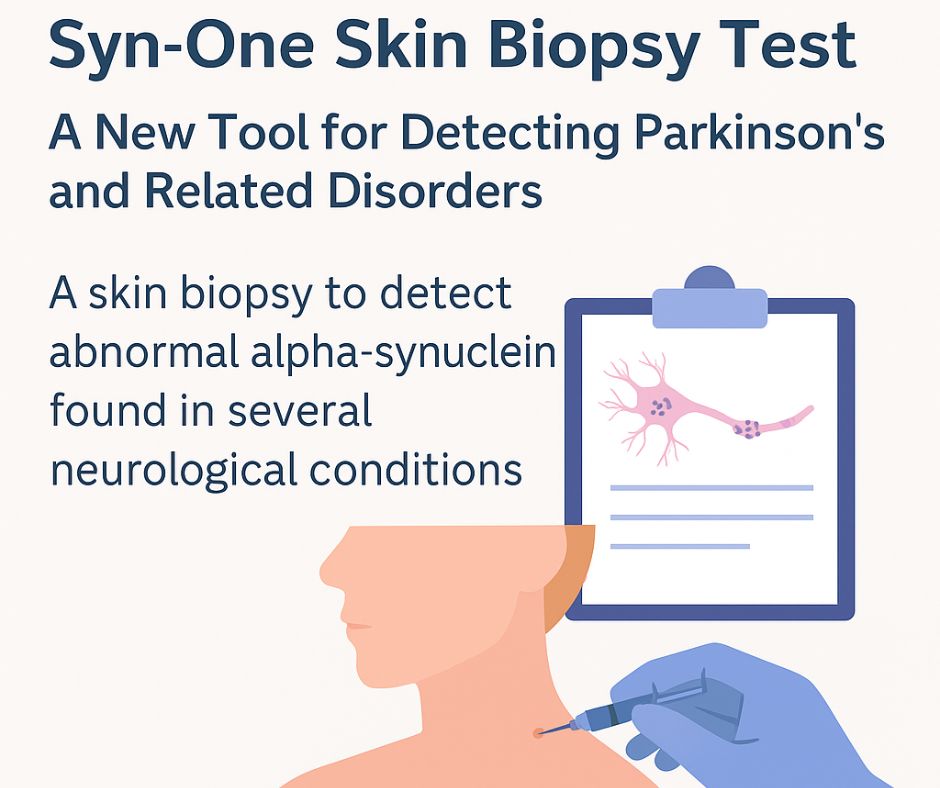
A new laboratory test using a simple skin biopsy is changing how Parkinson’s disease and related disorders may be identified.
The Syn-One Test detects abnormal alpha-synuclein, a key protein found in several neurological conditions.
Early research shows high accuracy, making this an important development for patients seeking clearer answers.
Quick Facts
The Syn-One Test® is a minimally invasive skin biopsy that looks for abnormal alpha-synuclein, a protein linked to Parkinson’s and related “synucleinopathies.”
Large studies report high sensitivity and specificity (often >90–95%) for detecting these disorders in people who already meet clinical criteria.
The test is performed in a CLIA-certified lab and is currently offered as a laboratory developed test (LDT), not as an FDA-cleared test.
The typical self-pay price is under $1,500, and many patients have a substantial portion covered by insurance, depending on their plan.
Experts view it as a tool to support or refine diagnosis in uncertain cases, not as a general population screening test.
Important Disclaimer
This article is for informational purposes only and is not medical advice. Diagnosis and treatment of Parkinson’s disease and other neurological disorders must be supervised by a qualified healthcare professional. Do not start, stop, or delay any medication or procedure based on this information without speaking to your doctor.
What Is the Syn-One Skin Biopsy Test?
The Syn-One Test® is a specialized laboratory test developed by CND Life Sciences. It uses small skin punch biopsies to look for the pathological, phosphorylated form of alpha-synuclein, a protein that builds up in nerve cells in a group of conditions known as synucleinopathies.
Synucleinopathies include:
Parkinson’s disease (PD)
Dementia with Lewy bodies (DLB)
Multiple system atrophy (MSA)
Pure autonomic failure (PAF)
For decades, these conditions have largely been diagnosed based on symptoms, neurological exam, and imaging. A test that can directly detect disease-related protein changes in living patients is therefore considered an important step toward more objective diagnosis.
How the Test Works
The Syn-One Test is typically performed in a neurologist’s or other specialist’s office. The doctor collects three very small (about 3 mm) skin punch biopsies from specific body sites, such as:
The back of the neck
Just above the knee (thigh)
Just above the ankle or lower leg
These biopsies are then sent to CND’s laboratory, where pathologists use advanced staining and imaging techniques to look for phosphorylated alpha-synuclein in the small nerve fibers within the skin. The lab also evaluates nerve fiber density and other features of nerve health.
The results are sent back to the ordering physician, who interprets them alongside the patient’s symptoms, exam findings, and other tests.
How Accurate Is It?
Several large studies have examined how well skin biopsy can detect phosphorylated alpha-synuclein in confirmed synucleinopathies. In a major NIH-sponsored multicenter study published in JAMA in 2024, researchers reported that skin biopsy detected the abnormal protein in:
Approximately 93% of people with Parkinson’s disease
Over 95% of people with other synucleinopathies (DLB, MSA, PAF)
Only a small percentage (around 3%) of control subjects without synucleinopathy
Across multiple studies, the test has shown high sensitivity and specificity for detecting synucleinopathies in carefully selected research populations. However, several important caveats apply:
These results come from specialized centers and research protocols, not from every community clinic.
Studies primarily included people who already met clinical criteria for a synucleinopathy.
More data are needed in broader, “real-world” settings to fully understand how the test performs in patients with unclear or early symptoms.
For these reasons, experts see Syn-One as a promising and helpful tool, but not a stand-alone or perfect test.
Who Might Consider the Test?
At this time, most neurologists and Parkinson’s organizations do not recommend the Syn-One Test as a routine screening test for the general public. Instead, it may be considered in situations such as:
Patients with parkinsonism or tremor where it is unclear if symptoms are due to Parkinson’s disease, an essential tremor, or other causes.
Cases with overlapping features of Parkinson’s, atypical parkinsonism, or dementia where diagnostic clarity may guide treatment decisions.
Patients with significant autonomic nervous system problems (blood pressure drops, severe constipation, etc.) where a synucleinopathy such as PAF or MSA is being considered.
In one recent clinical utility study, adding skin biopsy results led to changes in diagnosis or management for a large proportion of patients being evaluated for a possible synucleinopathy. However, the decision to use the test should be made case by case between patient and specialist.
Talk to Your Doctor
If you or a loved one is being evaluated for Parkinson’s or a related condition, ask your neurologist whether a skin biopsy test is appropriate in your specific situation. It may not be necessary in straightforward cases.
Cost and Insurance Coverage
Early on, the Syn-One Test was often a self-pay test around $1,500, with limited insurance coverage. As evidence has accumulated, coverage has expanded, especially among public payers.
Current reports suggest that:
The typical list price remains in the range of up to about $1,500.
The testing laboratory is a participating provider with Medicare and TRICARE, and is working to contract with commercial insurers.
In many cases, insurance covers a significant portion of the cost, and the patient’s out-of-pocket responsibility can be several hundred dollars or less, depending on deductibles and plan details.
Because coverage varies widely, it is very important to:
Ask the ordering physician’s office to obtain a cost estimate or pre-authorization when possible.
Contact the testing lab’s patient access or billing support team to clarify likely out-of-pocket costs.
Important Limitations and Cautions
While the Syn-One Test is an exciting advance, it has several key limitations:
It is currently offered as a laboratory developed test (LDT), not an FDA-cleared in vitro diagnostic. Oversight is through CLIA laboratory regulation rather than FDA device approval.
A positive test indicates abnormal alpha-synuclein in the skin, but does not always distinguish between Parkinson’s disease, DLB, MSA, or PAF on its own.
A negative test does not absolutely rule out a synucleinopathy, especially in early or atypical cases.
The test should always be interpreted within the context of a full neurological evaluation, not in isolation.
Expert groups emphasize that more data are needed before skin biopsy can be considered a universal standard for diagnosing Parkinson’s or related diseases.
For these reasons, the Syn-One Test is best thought of as a supportive biomarker that can increase or decrease a doctor’s level of diagnostic confidence, rather than a simple “yes/no” answer.
Natural Ways to Support Brain and Nerve Health
While diagnostic tools evolve, many people look for ways to support overall brain and nerve health. On Earth Clinic, readers have shared experiences with lifestyle and natural strategies such as:
A nutrient-dense diet emphasizing vegetables, healthy fats, and low processed sugar.
Regular movement and exercise appropriate to ability, including gentle stretching, walking, or physical therapy.
Stress-reduction practices such as meditation, breathing exercises, or time in nature.
Targeted nutrients (for example, magnesium, omega-3 fatty acids, antioxidant-rich foods) under the guidance of a knowledgeable practitioner.
These approaches do not replace conventional medical care, but may help support quality of life and general health.
Key Takeaway
The Syn-One skin biopsy test represents a significant advance in the quest for more objective, biologically based diagnosis of Parkinson’s disease and related synucleinopathies. Studies so far show high sensitivity and specificity in selected patient groups, and the test is now being used in specialized clinics around the United States.
However, it is not a perfect or stand-alone diagnostic tool, and it is not intended as a general screening test. Its greatest value may be in patients with uncertain or mixed symptoms, where additional clarity could meaningfully change diagnosis or treatment.
If you are concerned about Parkinson’s or a related condition, work closely with a neurologist or movement disorder specialist. Together you can decide whether a skin biopsy test, imaging, or other studies could be helpful in your specific situation.
The comments below reflect the personal experiences and opinions of readers and do not represent medical advice or the views of this website. The information shared has not been evaluated by the FDA and is not intended to diagnose, treat, or prevent any disease or health condition. Always consult a qualified healthcare professional for medical concerns.
There is now a skin biopsy test that's exclusive for Parkinson's. It's called the SynOne test and it's about $1500 but insurance should pay most of it. This is revolutionary since most of the time it's been diagnosed by symptoms alone. The test is approx 93% accurate which is also very good.
You must be logged in to this post! Please sign in:
Please note that we use cookies necessary for the functioning of our website, cookies that optimize the performance. To learn more about our cookies, how we use them and their benefits, please read our Privacy Policy