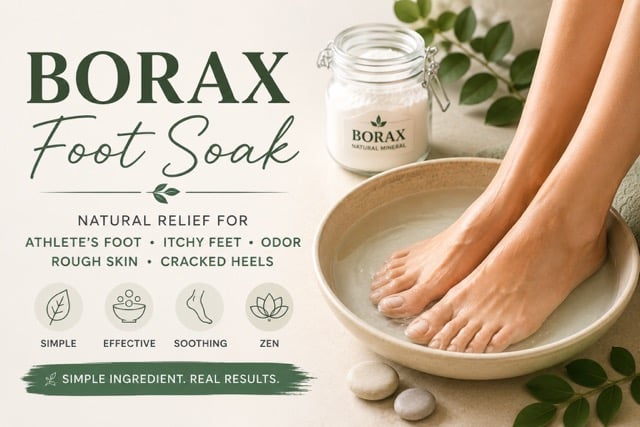
A borax foot soak is a simple home remedy discussed on Earth Clinic for itchy feet, athlete’s foot, foot odor, rough skin, and cracked heels. Borax, often sold as 20 Mule Team Borax, is an alkaline mineral compound traditionally used in laundry and household cleaning, but some readers have also used it externally in foot baths and foot hygiene routines.
The strongest Earth Clinic experiences for borax foot soaks involve athlete’s foot, foot fungus concerns, itching, rough feet, cracked heels, and shoe odor. This article explains how readers have used borax for foot soaks, how to make a basic borax foot bath, when apple cider vinegar is added, and what precautions to keep in mind.
At a Glance
Most common uses: athlete’s foot, itchy feet, foot odor, rough feet, cracked heels, and foot fungus concerns.
Basic recipe: 2 to 3 tablespoons borax in warm water for a 10 to 20 minute foot soak.
Stronger reader recipe: 3 heaping tablespoons borax plus 1 cup apple cider vinegar in hot water.
After soaking: dry feet thoroughly, especially between the toes, and apply moisturizer if skin is dry or cracked.
Use caution: do not use on open wounds, bleeding cracks, broken skin, or irritated skin that worsens with soaking.
What Is a Borax Foot Soak?
A borax foot soak is a warm foot bath made by dissolving borax powder in water. Some people use borax alone, while others combine it with apple cider vinegar for foot fungus, athlete’s foot, itching, or odor.
Borax is alkaline, which may help explain why some people find it useful for sweaty, itchy, or odor-prone feet. However, it can also be drying, especially when used too often or in a strong concentration.
For this reason, a borax foot soak is best approached as an occasional foot-care remedy rather than a daily long-term routine. Start mildly, observe how the skin responds, and stop if irritation develops.
Why People Use Borax Foot Soaks
Earth Clinic posts suggest that people are drawn to borax foot soaks when ordinary lotions, scrubs, files, powders, or over-the-counter creams do not fully solve the problem. The most common themes are fungus, itching, odor, and rough skin.
Athlete’s Foot
Some readers use borax externally for athlete’s foot itching and recurring foot fungus symptoms.
Itchy Feet
Itchy soles, toes, and feet are one of the main reasons readers try a borax foot bath.
Rough Feet
Readers with dry, rough, or thickened skin have reported noticeably softer feet after soaking.
Cracked Heels
Cracked heels are sometimes discussed alongside long-term foot fungus concerns and dry, thick skin.
Foot Odor
Borax is also used by some readers for shoe odor and foot hygiene when odor may be linked with moisture or fungus.
Shoe Soaks
One reader reported soaking shoes in borax-saturated water and letting them dry to discourage recurring foot fungus.
Basic Borax Foot Soak Recipe
This simple recipe is a good starting point for those who want to try a borax foot soak without making the solution too strong.
Basic Borax Foot Soak
2 to 3 tablespoons borax
1 gallon warm water
Foot basin or large plastic tub
Directions: Dissolve the borax in warm water. Soak feet for 10 to 20 minutes. Dry thoroughly, especially between the toes. Follow with moisturizer if the skin is dry or rough.
Use warm water rather than very hot water, especially if you have sensitive skin, poor circulation, diabetes, neuropathy, or reduced sensation in the feet.
Borax and Apple Cider Vinegar Foot Soak
One Earth Clinic reader used a stronger foot bath with borax and apple cider vinegar for a long-standing fungal foot problem and severely cracked heels. This combination may appeal to those already familiar with apple cider vinegar foot soaks.
Borax and Apple Cider Vinegar Foot Bath
3 heaping tablespoons borax
1 cup apple cider vinegar
Enough warm water to cover the bottoms of the feet and ankles
Directions: Dissolve the borax in warm water, add apple cider vinegar, and soak for 10 to 15 minutes. Dry feet completely afterward.
This is a stronger soak than the basic recipe. If your skin is sensitive, cracked, inflamed, or easily irritated, begin with the gentler borax-only version or avoid soaking until the skin has healed.
Borax Foot Soak for Athlete’s Foot
The most dramatic Earth Clinic report involved a man with a long history of athlete’s foot. After trying many store-bought products without lasting results, he wet his feet, rubbed borax over them, and reported that the itching stopped immediately. Weeks later, the symptoms had not returned.
This is an anecdotal experience, not a clinical study. Still, it helps explain why borax remains a popular remedy among readers looking for simple, low-cost foot fungus support.
For athlete’s foot, drying the feet thoroughly is just as important as the soak itself. Fungus thrives in warm, moist areas, especially between the toes and inside shoes.
Helpful Athlete’s Foot Habits
Dry between the toes after bathing or soaking.
Change socks daily, or more often if feet sweat.
Rotate shoes so each pair can dry fully.
Avoid tight, non-breathable shoes when possible.
Do not share towels, socks, or nail tools.
Borax for Itchy Feet
Itchy feet are one of the clearest benefits described in the Earth Clinic posts. One reader with insulin resistance and rough, itchy feet reported that borax worked wonderfully and that her feet stopped itching after use.
Itchy feet can have many causes, including athlete’s foot, dry skin, eczema, irritation from shoes or socks, contact dermatitis, neuropathy, or circulation issues. If itching is severe, recurrent, spreading, or accompanied by redness, swelling, sores, or drainage, it should be evaluated medically.
Borax for Cracked Heels and Rough Feet
Rough feet and cracked heels are common reasons people look for a borax foot soak. One reader with insulin resistance reported chronically rough feet and found that borax left them surprisingly soft after showering.
Another reader described long-standing foot fungus along with severely cracked heels. She used borax and apple cider vinegar in a morning foot soak and planned to continue reporting results.
Cracked heels may come from dry skin, thick calluses, prolonged standing, open-backed shoes, fungal infection, diabetes, thyroid issues, or circulation problems. If cracks are deep, bleeding, painful, or slow to heal, avoid strong soaks and seek appropriate care.
Borax for Foot Odor and Shoe Odor
Borax is often used in laundry because it helps with odors. For feet, readers may be interested in borax when odor seems linked with sweat, shoes, or possible fungal overgrowth.
A borax foot soak may help freshen the feet, but shoes and socks also need attention. If the same damp shoes are worn repeatedly, odor and fungus can return even after the feet improve.
Borax Shoe Soak Method
One Earth Clinic reader reported soaking shoes in borax-saturated water and letting them dry to help prevent recurring foot fungus.
Use caution with leather, suede, delicate fabrics, glued soles, or shoes that may be damaged by water. Test old or washable shoes first.
Can Borax Help Toenail Fungus?
Some people searching for borax foot soaks are also dealing with toenail fungus. A foot soak may improve the hygiene of the surrounding skin, but toenails are much harder to treat than surface skin because the nail plate is thick and slow-growing.
If toenails are thick, yellow, crumbly, lifting, painful, or worsening, a healthcare professional or podiatrist can confirm whether fungus is actually present. Other conditions can mimic toenail fungus, including trauma, psoriasis, eczema, and circulation problems.
Do not rely on borax alone for severe, spreading, painful, or long-standing nail disease.
Moisturizing After a Borax Foot Soak
Because borax is alkaline and can be drying, moisturizing afterward is important, especially for rough feet and cracked heels. Jessica’s Earth Clinic post specifically noted that once the feet become soft, a good moisturizer is the next step.
For Dry Feet
Use shea butter, coconut oil, olive oil, castor oil, or a thick natural foot cream after drying the feet.
For Cracked Heels
Apply moisturizer, then wear cotton socks for several hours or overnight if the skin is intact and not infected.
Between the Toes
Avoid heavy oils between the toes if athlete’s foot is present. That area should stay clean and dry.
Reader Reports of Detox Sensations
One Earth Clinic reader reported noticing a strong taste in the mouth during a borax and apple cider vinegar foot soak and wondered whether the soak might be related to detoxification. She described the sensation as occurring around the same time during each soak.
This is an individual observation and should not be taken as proof that borax foot soaks remove heavy metals or fluoride. The most practical, well-supported use of a borax foot soak on Earth Clinic is for foot hygiene, itching, athlete’s foot, odor, and rough skin.
Safety Precautions
Borax foot soaks are used externally. Because borax is alkaline, it may irritate sensitive skin or worsen dryness if the solution is too strong or used too often.
Do Not Use a Borax Foot Soak On:
Open wounds
Bleeding cracks
Infected skin
Severe redness, swelling, or drainage
Burning, raw, or highly irritated skin
Feet with reduced sensation unless medically approved
People with diabetes, neuropathy, poor circulation, immune suppression, or slow-healing wounds should be especially cautious with foot soaks. Even minor foot irritation can become more serious in these situations.
Troubleshooting Borax Foot Soak Problems
If your first borax foot soak does not go as expected, adjust the strength, frequency, and aftercare.
Feet Feel Too Dry
Likely cause: the soak is too strong or too frequent.
Try this: reduce the borax, soak less often, and moisturize after drying.
Skin Stings or Burns
Likely cause: irritated skin, cracks, or sensitivity to the solution.
Try this: stop the soak, rinse with plain water, and do not repeat until skin is calm.
Itching Gets Worse
Likely cause: irritation, allergy, eczema, or an infection that needs different care.
Try this: discontinue borax and consider medical evaluation if symptoms persist.
Fungus Keeps Returning
Likely cause: damp shoes, untreated socks, sweating, or reinfection.
Earth Clinic’s borax foot soak reports are limited but useful because they describe specific, practical uses.
Soft Feet and Less Itching
Jessica from Forest, Virginia reported rough, itchy feet and suspected systemic candida issues. After using borax, she said her feet were very soft and had not been itching. She also soaked shoes in borax-saturated water and let them dry to help prevent foot fungus.
Athlete’s Foot Relief
Dianna from Austin, Texas reported that her boyfriend had a long-term athlete’s foot problem that did not resolve with store-bought products. He wet his feet, rubbed borax over them, and said the itching stopped immediately. Weeks later, he reported that the problem had not returned.
Borax and Apple Cider Vinegar Soak
JS from Asheville, North Carolina used 3 heaping tablespoons of 20 Mule Team Borax with 1 cup of apple cider vinegar in hot water for a long-standing fungal foot problem and cracked heels. She soaked for 10 to 15 minutes each morning.
Frequently Asked Questions
How much borax do you use in a foot soak?
A gentle starting amount is 2 to 3 tablespoons borax in about 1 gallon of warm water. Some Earth Clinic readers have used stronger amounts, but it is best to begin mildly and adjust only if the skin tolerates it well.
How long should you soak your feet in borax?
Most people soak for 10 to 20 minutes. If the skin feels dry, tight, irritated, or itchy afterward, shorten the soak or reduce the amount of borax.
Can borax help athlete’s foot?
Earth Clinic readers have reported improvement in athlete’s foot itching and recurring symptoms after using borax externally. However, athlete’s foot can be persistent and contagious, so hygiene, dry socks, and dry shoes are also important.
Can borax help cracked heels?
Borax foot soaks may soften rough skin, but cracked heels need careful aftercare. Dry the feet well and apply a thick moisturizer. Do not use borax on bleeding, infected, or painful cracks.
Can borax help foot odor?
Borax may help with foot odor when odor is related to sweat, shoes, or fungal overgrowth. Shoe hygiene, clean socks, and fully drying footwear are also important.
Can I combine borax and apple cider vinegar?
Yes, one Earth Clinic reader used borax with apple cider vinegar in a foot bath. This combination may be too strong for sensitive or cracked skin, so start cautiously.
Is 20 Mule Team Borax used for foot soaks?
Yes. Earth Clinic readers commonly refer to 20 Mule Team Borax, the plain borax powder sold as a laundry booster. Avoid products with added fragrances, detergents, or other cleaning chemicals.
Can I soak shoes in borax water?
One reader reported soaking shoes in borax-saturated water and letting them dry. This may not be suitable for leather, suede, delicate shoes, glued soles, or shoes that can be damaged by water.
Can borax help toenail fungus?
A borax foot soak may support foot hygiene, but toenail fungus is harder to address because the nail is thick and slow-growing. Persistent, painful, or worsening toenail changes should be evaluated by a healthcare professional.
What should I put on my feet after a borax soak?
After soaking, dry feet thoroughly. For rough skin or cracked heels, apply a moisturizer such as shea butter, coconut oil, castor oil, olive oil, or a thick foot cream. Avoid heavy oils between the toes if athlete’s foot is active.
How often can I do a borax foot soak?
Start with 2 to 3 times weekly. If the skin becomes dry or irritated, use it less often. Daily use may be too drying for many people.
Can people with diabetes use borax foot soaks?
People with diabetes, neuropathy, poor circulation, or slow-healing skin should be very cautious with any foot soak. Avoid borax on cracked, open, infected, numb, or painful feet unless approved by a healthcare professional.
Bottom Line
A borax foot soak is a simple Earth Clinic remedy most often discussed for athlete’s foot, itchy feet, foot odor, rough skin, cracked heels, and shoe hygiene. The basic method uses a few tablespoons of borax in warm water, followed by careful drying and moisturizing as needed.
Start with a mild recipe, avoid broken or irritated skin, dry thoroughly between the toes, and pay attention to shoes and socks if fungus or odor keeps returning. Borax foot soaks may be helpful for some people, but persistent infections, severe cracks, diabetes-related foot problems, or worsening symptoms should be evaluated professionally.
The comments below reflect the personal experiences and opinions of readers and do not represent medical advice or the views of this website. The information shared has not been evaluated by the FDA and is not intended to diagnose, treat, or prevent any disease or health condition. Always consult a qualified healthcare professional for medical concerns.
Posted by David (Springfield, Missouri) on 11/08/2015 ★★★★★
Borax powder for Athlete's Foot cure
I have not read this one on the site, so thought I would share.
I sprinkle a liberal amount of borax powder, like the 20 Mule Team brand, over inside-out socks, then flip again to get them right side out. I wear them during the workday and after 2-3 days, all crusty feet are gone and I am left with, by comparison, baby-smooth skin on my feet. Amazing cure and much simpler than soaking your feet in ACV, etc.
Typically, I follow up with this every 3-4 months, or when I start noticing any rough skin between my toes, and a few days of this will stop it.
Be advised, if you have severe athlete's foot, you may lose a significant amount of dead/diseased skin on your feet the first day, which can be alarming. I recommended this treatment to a family member who had a very bad case and he was a bit disturbed by the amount of skin coming off his feet the first day. He decided to do borax soaks in a foot bath instead, so the reaction would be slower and less alarming, which it was. It was a complete cure for him in about a week, and he does the 3-4 month powder in the socks follow up as needed.
Other thoughts: Something about the heat, pressure, and moisture on your feet of a normal day's work seems to make this work better, as I have tried follow-up treatments on the weekend with just socks and does not seem as effective.
Also, more powder seems to work better than less, which can feel a bit odd as it seems you are walking with fine sand in your socks, but the sensation is unnoticeable to me in a few hours. I would estimate the quantity per sock at about 1-2 tablespoons. I have tried follow-ups with just a small sprinkling and that does not seem to work as quickly as the 1-2 tablespoon amounts.
Posted by Victor (Wisconsin, US) on 04/18/2015 ★★★★★
I had athlete's foot for many years, feet & shoes smelled terrible. One day I was reading the side of a box of borax, & there it stated that it removed odors. So I began to sprinkle borax into my shoes, and also into my socks. It made my feet hot, but in a few weeks it cured my athlete's foot, & has never returned. Now use it occasionally as insurance to prevent return infection.
After trying everything else you could buy at the store for his pretty much life long athletes foot problem - and not having results my boyfriend finally decided to try the remedy I kept telling him to try... borax - which he thought was poison him instantly but he 'trusted' the OTC stuff at the store!!! LOL
He wet his feet and then took a handful and rubbed it all over his feet.
He said they stopped itching immediately! He was stunned.
A few weeks later I asked him how his athletes foot was and he said: oh wow! It hasn't come back! That stuff totally cured it!!!
I have been trying to get rid of a fungal infection on my feet that I have had for years. Athlete's foot and now, in the past, 2 years, severely cracked heels (a sign of fungus, I have read). The over-the-counter creams that I have used do work, but they don't work permanently: the infection just moves around and later returns.
After reading up on the many of the remedies on Earth Clinic, I decided to make up my own recipe for a foot bath. So for the past 4 days, I have done the following:
3 heaping tablespoons of borax (20 mule team) dissolved in hot water, then added to a large tupperware storage container (cheap and perfect size for 2 feet).
Add 1 cup of apple cider vinegar.
Add enough hot water to cover my the bottoms of my feet and ankles.
I soak my feet for 10-15 minutes every morning.
I can't tell you at this point if it will cure the fungal infection. What I can tell you is that after 9 minutes, I get a very powerful taste in my mouth. It is the same taste I get when I am taking supplements to detox from heavy metals. What's weird is that it happens every day at the 9 minute mark. (Coincidentally, oil pulling causes my sinuses to open at the 9 minute mark too). I think that this foot soak may be a powerful way to detox from heavy metals, particularly fluoride. I hope other people will give it a try and give me their opinions. I will report back with more results in a week or two.
Posted by Gloria (Gaithersburg, Maryland) on 08/07/2012 ★★★★★
I wanted to pass on the success I've been having with treating my cracked heels and athlete's foot/toenail fungus. First, for a long time I didn't realize that all three of these were related ailments, especially the cracked heels which I had attributed to aging and dry skin. Now I realize it was symptomatic of a fungal infection.
I recently developed a "rash" on my ankle near my heel. At first I thought it was bug bites. It was a small cluster of red itchy dots. At first I tried ACV and H202 on them, but in a halfhearted way. It didn't really seem to help much. Then I got the idea to use borax, for some reason.
After bathing while my feet were still moist, I took about a teaspoon of borax powder in my hand and rubbed it all over my feet, heels, ankle, between toes, etc. The itching from the rash stopped and my feet felt "good. " I left the powder on my feet (a very thin coat remained) and went to bed. I repeated this for a few nights. The rash has been scabbing over and healing (I still don't know what caused it -- fungus or something else).
But the remarkable thing is the skin on my heels! It is healing, getting softer, younger-looking. My heels had been cracked, dry and ugly for about 5 years! I've been doing this for two weeks now, and the improvement is remarkable.
As well, my toenail fungus and athlete's foot between my toes is going away. I now have "pretty feet" and I am not ashamed to go out wearing my sandals (and no nail polish, either, to hide the ugly nails! They look normal, now).
I have also started applying a homemade ointment to my feet each morning, consisting of coconut oil, aloe, tea tree oil and lavender. This feels soothing and I think it's helping, too, but the borax seems to be the main thing.
Posted by Jessica (Forest, VA, USA) on 12/19/2007 ★★★★★
I'm insulin resistant, so I have alot of the same problems that diabetics do, including rough feet. I've tried so many scrubs and files and lotions in hopes of softening my feet. I suspect that I also have a systemic Candida infection, so I thought Borax would be good for my itchy feet. It worked wonderfully! My feet were so soft after I got out of the shower and have not been itching since. Once you get your feet nice and soft, you'll want to follow with a good moisturizer: that's where my next project lies.
Replied by Blackbeltbty (Goodyear, Arizona)
08/05/2009
A really good skin softener for your feet would be to use 1/4 cup of castor oil, 1/4 cup of olive oil and 1/4 cup of mineral oil and 7 drops of a lemon essential oil for fragrance. I had the same problem and combined this mixture along with using the borax and the results were unbelievable! I hope it works for you as well.
A great product for rough feet and foot fungus is coconut castile body wash. It clears the problem after a few uses. You can also use coconut oil to moisturize your feet. Just wear cotton socks and slippers so you don't damage your carpeting.
They were simply remedies for sweaty feet furnished by soldiers and Allies. An Irishman said that his remedy was the best. Bathe the feet in a dish pan with one teaspoonful of borax added. Soak for 20 minutes. Then dry them and add rub spirits of camphor.
From the book, The Officer's Responsibility for His Men Published 1898 page 34.
You must be logged in to this post! Please sign in:
Please note that we use cookies necessary for the functioning of our website, cookies that optimize the performance. To learn more about our cookies, how we use them and their benefits, please read our Privacy Policy