




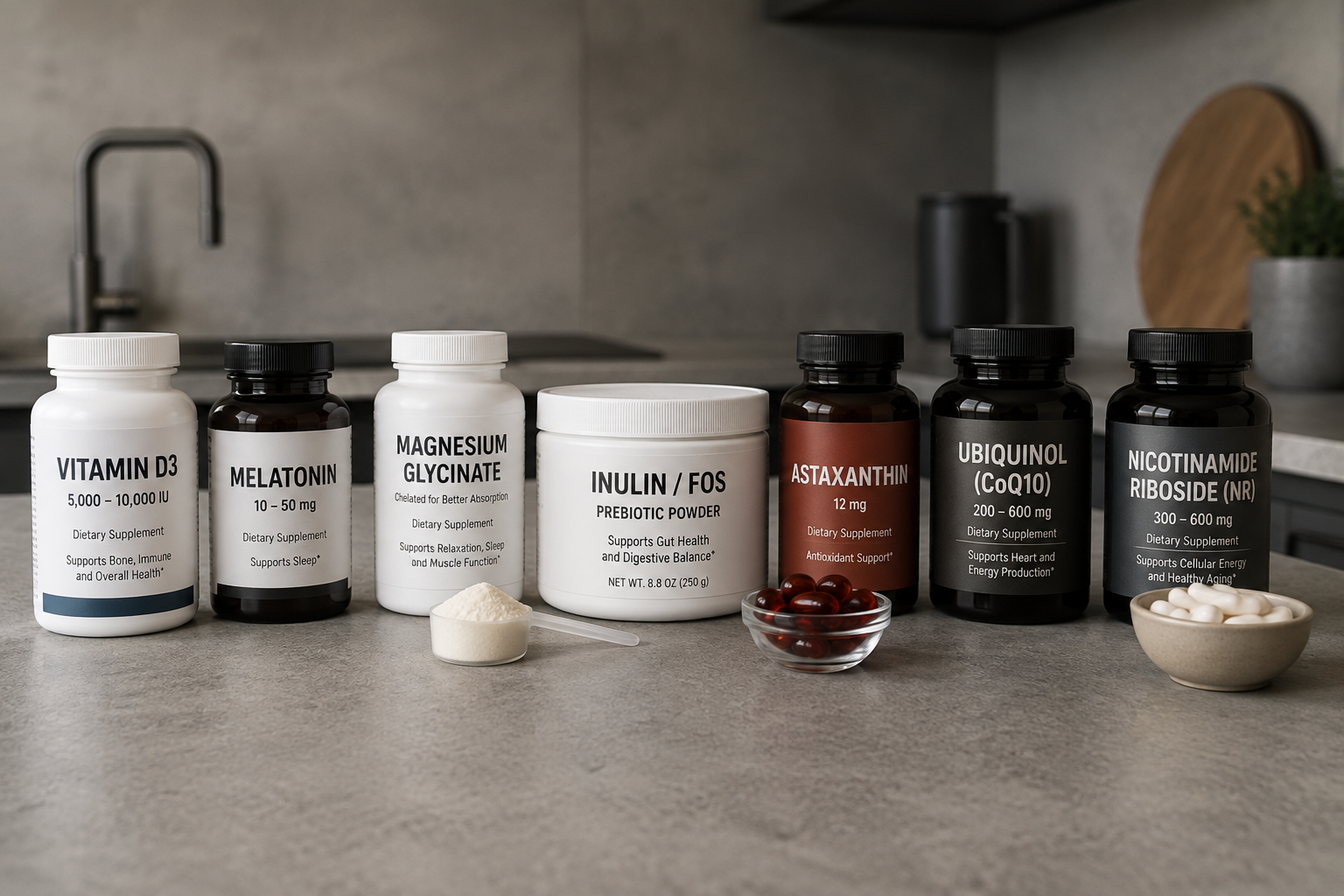
Broad Benefits
★★★★★

Although I introduced the Positive Health Loop as useful for Alzheimer's disease and possibly Parkinson's disease, because of its multiple mechanisms of activity, it has many other uses when it comes to human health. To give a basic example, I would like to describe what I have noticed in terms of my health after recently completing 5 months on the PHL.
I started on the PHL last year in 2025, but did not incorporate the full PHL until March 1,2026. So as of the end of July 2026, I will have completed 5 months on the full PHL and this is what I have noticed.
1. Noticeably improved mood and more even and tempered responses to stressful situations. I did not initially notice this effect, but it was told to me by multiple people around me and friends who explained how I used to react to stressful situations and how I now react much more calmly. Two people told me I seem like a different person now, but in a good way. Apparently this was one of the first indications that the PHL is working for me. Now the changes are obvious to even me and I must admit, this one kind of surprised me.
2. Improved sleep and easier to get to sleep within the first 1.5 months of being on the PHL. Several months further down the road and sleep has improved further with sometimes falling asleep within a few minutes of laying down and feeling more rested in the morning.
3. Improved ability to do my 2 mile brisk morning walk. The limiting factor for me is that my legs would hurt, feel severely fatigued and would sometimes cramp up or teeter on cramping and this would limit how fast I could walk. If I pushed too hard the pain, fatigue and cramping would become unbearable. This meant I was taking about 32 or more minutes to complete my two mile walk. Now, at just under 5 months in, my fastest time has been 27.25 minutes with no pain, no cramping and minimal fatigue and recovery time is just a few minutes. It seems like so far, no matter how hard I push myself on my walk, the muscle cramping and pain no longer occur. My endurance for this walk has significantly increased.
On 7/28/26, I was able to break through the 27 minute elapsed time for my 2 mile brisk walk recording a time of 26.06. Two days later I was able to break below 26 minutes with an ET of 25.51 and although I was pushing myself really hard on this last walk, there was no muscle cramping, excess fatigue, pain or next day soreness. For now, that is my best time, but just being able to push myself hard on the walk without problems is a drastic change for me.
4. I have high blood pressure, which with no medication, was showing systolic readings over 200, diastolic readings over 100 and pulse readings over 100. With prescription medication, these numbers only came down minimally. So I found a supplement that brought me down to the normal range, but then it brought me down further to hypotension range at one tablet per day. So I started taking it every other day and my blood pressure came up, but was still slightly in the hypotensive range.
So I went to every third day and that brought me to just under normal blood pressure so I went to every fourth day and I started getting hypertensive readings again. I settled on every third day and that kept my blood pressure well controlled for about a year, but then my blood pressure started to climb again and I had to start taking a pill every other day. After awhile, my blood pressure started to rise again and I ended up back at one pill everyday, which was the recommended dose I started with. That was about 3 years ago if I remember correctly and my blood pressure has remained well controlled in the normal range up until about 3 to 4 months ago and after I had started the PHL. At that time I noticed my blood pressure started to drop and stay lower so I switched to a pill every other day which brought me back to the normal range, but I didn't give it much thought.
About 6 weeks ago my blood pressure started dropping again so I went to one pill every third day and my blood pressure came back to the normal range, but within about three weeks, my blood pressure dropped further so I went to one pill every fourth day and my blood pressure came up a little but was still under the normal range so I went to one pill every fifth day and my blood pressure returned to the normal range or just below with the fifth day showing at slightly above normal with a reading of 132 over 82 . So this is where I currently am testing one pill every fifth day. My next pill will be this coming Sunday. These results are better than when I started on the blood pressure supplement over 4 years ago. My pulse readings now vary between 58 and 78. The one pill every 5th day is continuing to work with my blood pressure readings showing normal or slightly below or slightly above normal. I don't know yet if I will have to go back to one pill every fourth day, but I will if needed.
5. I can now put my socks on while standing in one place and maintain my balance without having to lean against something or grab on to something. This was always very difficult for me or sometimes impossible to put my socks on standing up, but now I can and it is fairly easy. So I would say that my balance has improved to some degree.
6. Improved and regular bowel movements with no constipation at all so far, whereas before I could get occasional constipation and not be very regular.
7. I have had mild to moderate hand tremor for decades going back to my mid to late 30's and it has been in both hands while slightly worse in the left hand, but while being on the PHL, both my right and left hand tremors have reduced to zero or near zero, unless I am significantly stressed which can cause a mild tremor. The change was so gradual, I am not certain when it stopped, but it was after starting on the PHL. The right hand tremor seemed to diminish before the left hand tremor did. I do not have PD, so I always assumed this to be essential tremor.
8. Ankle and foot swelling in both legs has reduced by at least 98% at about 5 months into the full PHL. This has happened gradually over the past 2 to 3 months that I started noticing reduced swelling and I only drew the connection to the PHL more recently even though I could see the obvious reduction in swelling each week. My socks no longer leave visible indentations around my ankles and my shoes never feel tight anymore.
9. My triglycerides and VLDL were 127 last September and 25 respectively one year ago and my recent lipid panel showed my triglycerides at 84 while my VLDL is currently 17.
So this is what I have noticed at 5 months completed into the full PHL. If there are other benefits, I am not aware of them or they are internal improvements that I can not see or quantify. Obviously I will be continuing the PHL indefinitely because I consider these benefits significant and of substantial magnitude and inline with some of the 30 posts I have put up on HU about the PHL. From what I can tell so far, the PHL seems to be having a positive impact on my vasculature system and this is inline with AI's projections.
Art
(Idaho)
08/10/2026
Hi Art, your protocol looks fantastic, and the results seem even more fantastic! Thank you for sharing with us. I was planning to get some NMN powder. Now after seeing your protocol, I may try NR instead. I know many people use either NR or NMN for boosting NAD levels. Do you have an opinion on NMN, and did you choose NR for a specific reason?
Hi Madelyn,
Thank you for saying so!
NR is generally considered preferential to NMN for neurodegenerative issues like Parkinson's disease and Alzheimer's and in my case, for psoriasis, NMN is considered the first option and I think similarly for diabetes. So I use NMN powder which I place under the tongue and let dissolve on its own. It isn't great tasting, but it isn't horrible tasting either. The taste doesn't seem to be a problem for me. It is very poorly absorbed sublingually, but it helps get some of the NMN into your system quicker. It is a routine for me now and I just take it shortly after awakening. The downside to the powder over capsules is that you will initially need a digital milligram scale to figure an appropriate sized measuring device to get the dose you will be using. NR and NMN are best taken in the morning and taking it later than lunchtime may interfere with sleep in some people.
Boosting NAD+ as we age is important because by our 40's NAD+ has declined significantly and it has an enormous amount of positive health effects in the human body. Even though a recent study showed that TRU NIAGEN did not have disease modifying effects in people with PD, it does not mean that NAD+ does not have beneficial health effects in people and when combined with the other components of the Positive Health Loop (PHL) and all of its synergies, NAD+ does definitely have many positive health effects and it synergizes with the rest of the PHL. Context matters.
I haven't discussed it yet, but the PHL has many health effects that will be useful for many other health issues than just AD and PD. The PHL isn't trying to cure any specific disease, it is trying to restore specific systems of the body and increase those systems resilience to a point where the body is able to more effectively hold certain health issues at bay.
To give an idea of what I am trying to describe, lets look at Parkinson's disease (PD). In PD, science has determined that the disease was active, 10, 20 or even 30 years before it progressed enough for a doctor to be able to diagnose it. That means that during those 10 to 30 years, the body was using multiple systems to very significantly slow disease progression at a level unmatched by anything currently available for PD, with most available prescriptions doing nothing or almost nothing to slow disease progression and mainly just treating symptoms. Unfortunately those systems of the body decline with age and decline even more so in a disease state such as PD, allowing the disease to slowly increase the rate of progression with even more rapid progression after diagnosis. So the PHL is attempting to improve the resilience of these declining body systems. Many of the components of the PHL have levels in the body that have declined significantly and restoring some of those levels is part of what the PHL is trying to do.
As an example of one body system the PHL is working to restore efficiency and resilience in, the mitochondrial system would be an important one since it can lose efficiency and resilience with age and even more so with disease. All 8 components are working to improve the efficiency and resilience of the mitochondrial system from different angles. This creates synergy between the individual components in this process making the total effect on the mitochondrial system by the PHL, more than just the sum total of the individual components.
I will discuss other health issues that the PHL is likely to be useful for in future posts.
Art
