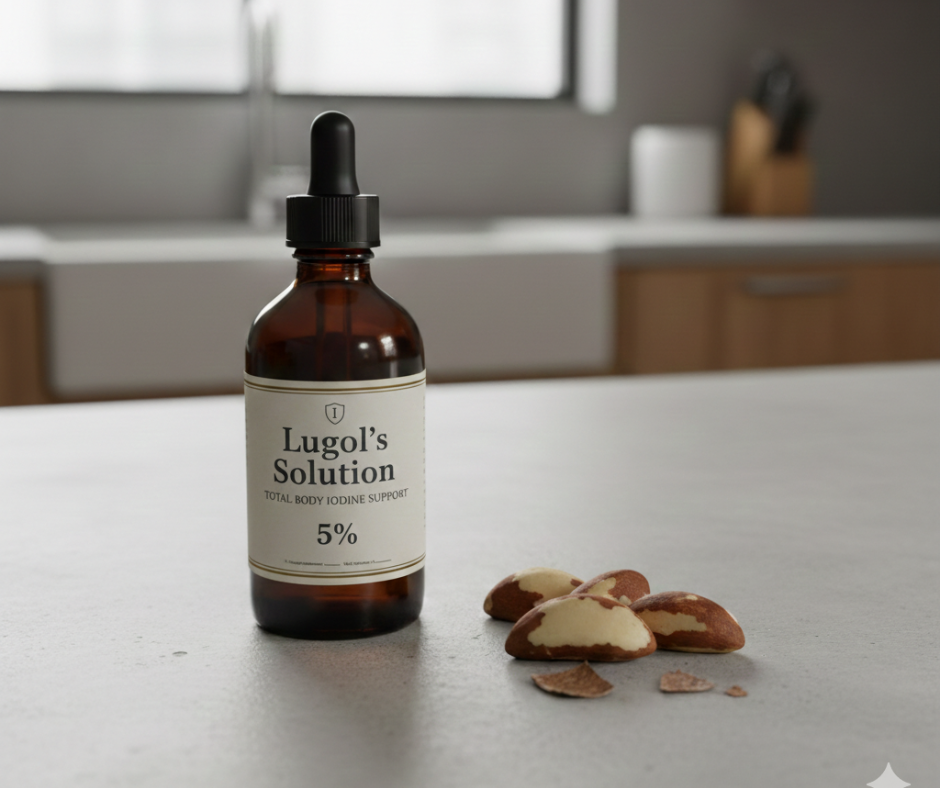
Lugol’s Iodine is one of the most discussed mineral remedies on Earth Clinic and remains widely used in 2026 for thyroid support, metabolic health, immune resilience, breast health, halogen detoxification, and mitochondrial energy production.
Because modern food systems are increasingly iodine-poor—and because humans are exposed to large amounts of competing halogens like bromide, fluoride, and chlorine—many integrative practitioners believe iodine deficiency is becoming increasingly common.
Many Earth Clinic readers use Lugol’s iodine as part of broader wellness protocols involving energy production, detoxification, thyroid resilience, breast tissue support, and environmental toxin reduction. However, iodine is powerful and should always be used thoughtfully and carefully.
At a Glance: Lugol’s Iodine Benefits
One of the reasons Lugol’s iodine remains so popular is that it delivers both major biologically useful iodine forms in one aqueous solution: molecular iodine (I2) and potassium iodide (KI).
Different tissues appear to use these forms differently. The thyroid primarily concentrates iodide, while breast, ovarian, prostate, gastric, and immune tissues are often discussed in relation to molecular iodine.
| Form | Primary Tissue Use | Role |
|---|---|---|
| Potassium Iodide (KI) | Thyroid | Supports thyroid hormone production |
| Molecular Iodine (I2) | Breast, prostate, ovarian, gastric, and immune tissues | Supports tissue architecture, antioxidant balance, and cellular signaling |
Many practitioners believe this dual-form structure makes Lugol’s more complete than isolated iodide supplements alone.
In 2026 longevity medicine, iodine is increasingly discussed not just as a thyroid mineral, but as part of broader mitochondrial redox signaling networks.
Thyroid hormones strongly influence:
Low iodine intake may contribute to sluggish metabolism, cold intolerance, fatigue, hair thinning, poor exercise tolerance, and reduced mitochondrial resilience.
2026 Biohacker Insight: Some practitioners describe iodine as a “redox mineral” because it participates in antioxidant signaling and supports oxidative balance inside cells.
Iodine belongs to the halogen family alongside bromine, chlorine, and fluoride. These elements can compete with iodine for receptor sites and transport systems in the body.
Modern exposure sources may include:
Many Earth Clinic readers use Lugol’s iodine specifically as part of a Halogen Displacement Protocol, especially when they suspect bromide or fluoride burden.
The body transports iodine into cells using a protein called the Sodium-Iodide Symporter (NIS).
This symporter is highly active in:
Bromide and fluoride may interfere with iodine uptake through symporter competition, effectively blocking iodine from entering cells efficiently.
Why Salt Flushes May Help: The Sodium-Iodide Symporter requires sodium to transport iodine into cells. This is one reason some practitioners include unrefined salt during bromide detox protocols.
The medical term bromism refers to symptoms associated with bromide excess or toxicity.
Readers sometimes report temporary detox symptoms when increasing iodine intake too quickly:
Many interpret these reactions as bromide displacement rather than true iodine intolerance. However, strong symptoms are a signal to slow down, reduce dosage, or pause.
Experienced iodine users often believe Lugol’s works best alongside specific companion nutrients that support thyroid enzymes, detoxification, antioxidant balance, and ATP production.
| Nutrient | Typical Daily Target | Why It’s Essential |
|---|---|---|
| Selenium | 200 mcg | Helps protect thyroid tissue from oxidative stress generated during thyroid hormone production. |
| Magnesium | 300–400 mg | Supports detoxification enzymes, nervous system balance, and ATP production. |
| Vitamin C | 1,000–2,000 mg | Buffers oxidative stress during detox and supports transport systems. |
| Riboflavin (B2) | 100 mg | Supports ATP pathways, iodine metabolism, and energy production. |
One of the most discussed non-thyroid uses of iodine is support for fibrocystic breast tissue and estrogen balance.
Some researchers believe iodine helps regulate estrogen receptor signaling in breast tissue and may support healthier tissue architecture.
This is one reason many women exploring iodine protocols also investigate:
Molecular iodine (I2) appears especially important in discussions of breast tissue physiology and hormone balance.
People with Hashimoto’s thyroiditis or elevated Thyroid Peroxidase (TPO) antibodies should use extra caution with iodine supplementation.
In some individuals, high-dose iodine may aggravate autoimmune thyroid activity if selenium status and antioxidant systems are inadequate.
Important: Individuals with Hashimoto’s, elevated TPO antibodies, Graves’ disease, nodules, or thyroid medication use should work with a knowledgeable practitioner when using therapeutic iodine.
These are common reference calculations for Lugol’s liquid drops. Actual drop size varies depending on dropper angle, viscosity, and bottle type.
Many Earth Clinic readers begin far lower than these amounts and increase gradually over time.
Temporary symptoms such as brain fog, metallic taste, fatigue, acne-like breakouts, or sinus drainage may occur when iodine displaces bromide too quickly.
A commonly discussed salt flush method is:
Lugol’s iodine is also widely used topically for first-aid and skin-support purposes.
Temporary orange-brown staining is normal.
Those with thyroid disease should work with a qualified healthcare practitioner when using iodine therapeutically.
In 2026, iodine research increasingly overlaps with:
Many readers now view iodine not simply as a “thyroid mineral,” but as a broader metabolic and endocrine support nutrient.
Continue reading below to explore Earth Clinic reader experiences with Lugol’s iodine, bromide detox, thyroid support, hormone balance, and topical use.