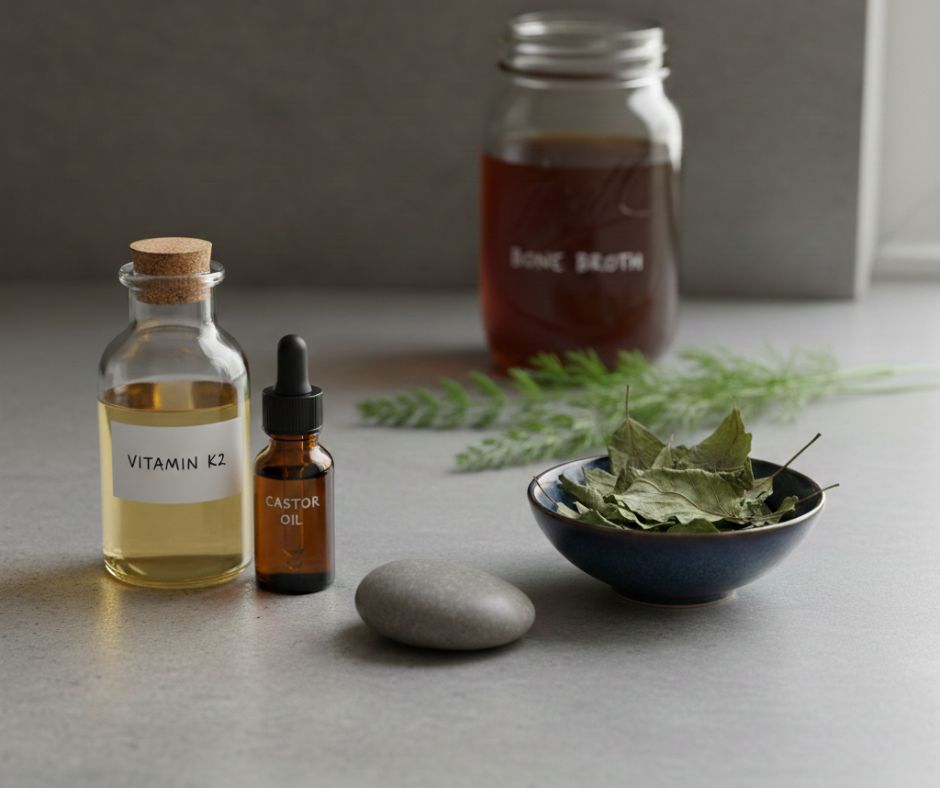
A bone fracture is a structural injury that requires proper alignment, stability, and time. But healing speed and final bone strength are influenced by your internal “construction environment”: protein availability, mineral absorption, inflammation signaling, circulation, hydration status, sleep, and what you do (or don’t do) during recovery.
Earth Clinic readers want more than “wait it out.” They want to know what actually helps the body lay down stronger bone tissue faster—and what quietly interferes with that process.
Quick Nav:
▸ First Phase Care
▸ Food & Protein
▸ The Absorption Factor
▸ Minerals & K2
▸ Collagen Support
▸ Comfrey Poultice (Gold Standard)
▸ Traditional Knitbone & Homeopathy
▸ Nerve & Soft Tissue Support
▸ Micro-Circulation, PEMF & Contrast
▸ Wolff’s Law & Rehab
▸ What Slows Healing
▸ When to Seek Care
▸ FAQ
Safety note: Always have a suspected fracture evaluated. Natural remedies support the body’s repair environment but do not replace proper reduction, immobilization, or surgery when indicated.
First Phase Care: Stabilize, Drain Swelling, Protect Alignment
- Immobilize initially to allow the repair callus to form.
- Elevate to reduce pooled edema.
- Cold early for swelling; heat later once swelling calms to support circulation.
Healing mechanics: Bone forms a soft collagen callus first, then mineralizes into hard bone. Stability + circulation + minerals drive this transition.
Food Foundation: Protein, Calories & Bone-Building Meals
- Protein: Required to build the collagen scaffold of new bone.
- Adequate calories: Aggressive dieting slows repair.
- Vitamin C foods: Support collagen cross-linking.
- Vitamin K foods: Help minerals bind correctly into bone matrix.
- Mineral-rich foods: Sardines, sesame, dairy (if tolerated), leafy greens.
The Absorption Factor (How Minerals Actually Reach the Bone)
If digestion is weak, even a perfect mineral program won’t rebuild bone efficiently.
- Low stomach acid reduces calcium and magnesium breakdown.
- Digestive bitters before meals stimulate acid and enzyme release.
- The ACV trick: 1 teaspoon apple cider vinegar in water before mineral-rich meals to improve mineral absorption.
Key Minerals & The Vitamin K2 “Traffic Cop”
- Calcium: Structural building block (diet first).
- Vitamin D: Gets calcium into the bloodstream.
- Vitamin K2 (MK-7): The “GPS” that directs calcium into bone and away from arteries and kidneys (the Calcium Paradox).
- Magnesium: Required for mineral placement.
- Boron: Improves utilization of calcium and vitamin D.
- Silica: Supports collagen mineralization.
Collagen & Scaffold Support
- Collagen or gelatin daily
- Vitamin C alongside collagen
- Bone broth as traditional support
Comfrey Poultice (Earth Clinic Gold Standard)
Comfrey is traditionally called “knitbone.” Readers report reduced pain and faster tissue repair around fractures when used properly on intact skin.
- Apply to skin near fracture (not on open wounds).
- 1–2 times daily during early healing.
- External use only.
Cast management: If the fracture is in a hard cast, apply comfrey, castor oil, or magnesium gel to the closest accessible skin above or below the cast to utilize local and systemic absorption. Modalities like PEMF and red light therapy can penetrate casts and reach deeper tissue.
Traditional Knitbone & Homeopathic Support
- Horsetail (Equisetum) tea: High-silica support for collagen mineralization.
- Castor oil packs: Reduce surrounding soft-tissue inflammation and tightness.
- Symphytum officinale 30C (homeopathic): Internal “knitbone” remedy for deep bone pain and repair signaling.
- Arnica (homeopathic pellets): Useful in early injury phase for bruising and trauma response.
Nerve & Soft Tissue Support (Zingers, Tingling, Phantom Sensations)
Fractures often compress or stretch nerves. As nerves regenerate, people experience sharp “zingers,” tingling, or numb patches.
- B-Complex: Supports nerve repair signaling.
- Alpha Lipoic Acid: Antioxidant support for regenerating nerves.
- Gentle massage around (not on) fracture: Improves local circulation.
Micro-Circulation, PEMF & Contrast Therapy
- Red Light Therapy / PEMF: Support nitric oxide signaling, circulation, and osteoblast activity; PEMF can penetrate casts.
- Contrast hydrotherapy: 3 minutes warm / 1 minute cool cycles to “pump” edema out of a limb.
Wolff’s Law & Graduated Loading
Bone strengthens in response to stress. Once medically cleared, gradual weight-bearing and physical therapy stimulate stronger bone remodeling. This is how “stronger than before” bone is built.
What Can Slow Bone Healing (And Why)
- Smoking/nicotine: Reduces blood flow to bone.
- Heavy alcohol: Suppresses osteoblast activity.
- Low protein intake: Weak collagen scaffold.
- Long-term NSAIDs: Prostaglandin inhibition can blunt the early inflammatory signal needed to trigger repair callus formation. Discuss acetaminophen or natural alternatives during the first 1–2 weeks with your doctor.
- Dehydration: Thickens blood and slows micro-circulation to the fracture site.
When to Seek Urgent Care
- Open fractures or deformity
- Worsening pain or swelling
- Numbness or loss of circulation
- Fever or foul odor from cast
- Calf pain or shortness of breath after leg fracture
FAQ
What most affects final bone strength?
Protein intake, mineral absorption (K2 + D), hydration, circulation, and proper rehab loading.
Why hydration matters for bone?
Bone is ~25% water. Dehydration thickens blood and reduces delivery of minerals and oxygen to healing tissue.
Have a remedy that helped your fracture heal? Share what bone was fractured, what you used, when you started, and how your recovery progressed.